
Introduction
Private jet charter allows travelers to hire an aircraft for a specific journey without owning a private jet. It offers greater flexibility in scheduling, airport selection, and onboard privacy compared with conventional airline travel. However, first-time travelers need to understand aircraft categories, pricing, booking procedures, and operational considerations. This guide explains the fundamentals of private jet charter in simple terms.
What Is a Private Jet Charter?
A private jet charter is a service in which an individual, family, business, or group hires an aircraft for a particular trip. Unlike commercial airline travel, where passengers purchase individual seats on a scheduled flight, a charter customer generally arranges the aircraft according to a specific itinerary.
The aircraft is operated by a qualified flight crew and is normally arranged for the requested route and schedule. Depending on the journey, travelers may be able to depart from airports that are not served by regular commercial airlines.
Private jet charter should not be confused with private jet ownership. Ownership involves purchasing and maintaining an aircraft, while chartering provides access to an aircraft only when it is needed.
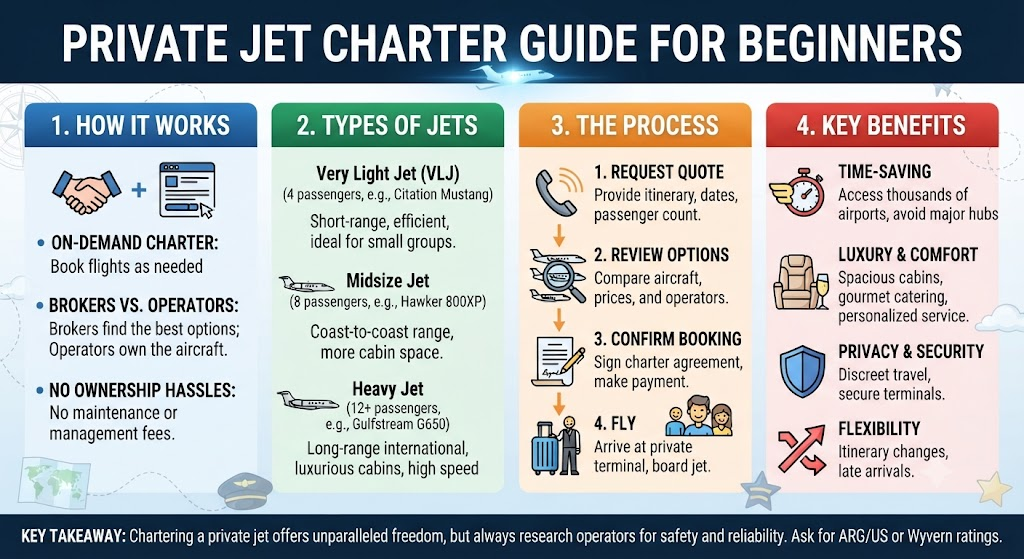
How Private Jet Charter Works
The charter process is relatively straightforward, but several details need to be confirmed before a flight is finalized.
1. Decide the Travel Requirements
Start by determining the basic requirements:
- Departure location
- Destination
- Travel date
- Preferred departure time
- Number of passengers
- Baggage requirements
- One-way or round-trip travel
- Special passenger requirements
These details help determine which aircraft and airports are suitable.
2. Select an Appropriate Aircraft
Different aircraft have different passenger capacities, cabin dimensions, baggage capabilities, and ranges. A short domestic trip for a small group may require a very light or light jet, while a long international journey may require a larger long-range aircraft.
3. Receive and Review a Charter Quotation
A charter provider or operator will generally prepare a quotation based on the requested itinerary. The quoted amount may depend on aircraft availability, flight time, positioning requirements, airport charges, crew expenses, and other operational factors.
It is important to understand what is included in the quotation and whether additional charges could apply.
4. Confirm Passenger and Flight Details
Passenger names, identification information, baggage details, and other required information need to be provided accurately. International flights can involve additional documentation and entry requirements.
5. Complete the Booking
Once the aircraft, schedule, price, and terms have been reviewed, the booking can be confirmed according to the provider’s procedures.
6. Prepare for Departure
Private aviation often uses dedicated terminals or fixed-base operator facilities. Travelers should confirm the exact departure location, arrival time, parking or ground transportation arrangements, and any security or documentation requirements.
7. Complete the Flight
After boarding, the aircraft operates according to the agreed itinerary, subject to weather, air traffic, airport restrictions, and other operational considerations.
Types of Private Jets Available for Charter
Private jets are available in several broad categories. The categories can vary slightly between operators and aircraft classification systems, but they provide a useful starting point for beginners.
Very Light Jets
Very light jets are designed for smaller groups and relatively short trips. They generally have compact cabins and may be suitable when passenger numbers and baggage requirements are limited.
Light Jets
Light jets offer more cabin space than very light jets and are commonly considered for short- to medium-distance journeys. They can be useful for business travel, regional trips, and smaller groups.
Midsize Jets
Midsize jets generally provide more cabin space, greater range, and additional passenger comfort. They can be suitable for longer domestic journeys and some international routes, depending on the aircraft and operating conditions.
Super Midsize Jets
Super midsize jets typically combine substantial cabin space with longer-range capability. They may be appropriate for larger groups or longer journeys where passengers want more room and additional onboard amenities.
Heavy and Long-Range Jets
Heavy and long-range aircraft are designed for larger passenger groups and longer journeys. Depending on the aircraft, they can provide spacious cabins, sleeping arrangements, larger baggage areas, and extended range.
The appropriate aircraft depends on the specific route rather than simply selecting the largest available jet.
How to Choose the Right Private Jet
Choosing a private jet involves more than looking at passenger capacity.
Number of Passengers
The number of travelers is one of the first factors to consider. A small group may not need a large aircraft, while a bigger group may require additional cabin and baggage capacity.
Flight Distance
Aircraft have different ranges. A jet suitable for a short domestic route may not be appropriate for a long international journey.
Baggage
Baggage capacity varies between aircraft. Travelers carrying large luggage, sporting equipment, musical instruments, or other specialized items should communicate these requirements before selecting the aircraft.
Cabin Space
Passengers should consider how much cabin space they actually need. A larger cabin can provide more comfortable seating and room to move around, particularly on longer flights.
Airport Availability
Not every private aircraft can operate from every airport. Runway length, aircraft performance, weather conditions, airport operating hours, and other factors can affect airport suitability.
Budget
The aircraft should match the travel requirements without paying for unnecessary capacity. Selecting a larger aircraft simply because it offers more features may not be economical for a short journey with few passengers.
Understanding Private Jet Charter Costs
Private jet charter pricing is not usually based on a simple fixed ticket price. The total cost depends on the aircraft and the entire operational requirements of the trip.
Several factors can influence the final quotation.
Aircraft Type
Larger and longer-range aircraft generally have higher operating costs. They may require more fuel and have greater crew and maintenance expenses.
Flight Time and Distance
Longer flights normally require more aircraft operating time and fuel. The route itself can also influence the overall cost.
Positioning Flights
An aircraft may need to travel to the passenger’s departure airport before the charter begins. It may also need to reposition after dropping passengers at their destination.
These additional movements can affect the total charter cost.
Airport Charges
Landing, parking, handling, navigation, and other airport-related charges may contribute to the overall price.
Crew Expenses
Longer journeys may require additional crew arrangements, overnight stays, or other operational considerations.
Seasonal Demand
Demand for private aircraft can change depending on holidays, major events, business travel periods, and other seasonal factors.
For this reason, beginners should focus on understanding the complete quotation rather than comparing only a basic advertised hourly rate.
One-Way vs. Round-Trip Charter
A one-way charter involves traveling from the departure airport to the destination without arranging a return flight for the same itinerary.
A round-trip charter includes both the outbound and return journey.
A common mistake is assuming that a one-way charter will always cost exactly half of a round trip. Private aircraft may need to be repositioned after completing a one-way journey. The aircraft’s availability, location, and subsequent schedule can therefore affect pricing.
A round trip can sometimes be operationally more efficient, but this depends on the itinerary and aircraft.
Empty-Leg Flights Explained
An empty-leg flight occurs when an aircraft needs to fly without passengers because it is repositioning for another scheduled journey.
For example, a jet may carry passengers from City A to City B and then need to return to City A without passengers. That return movement could potentially be offered as an empty-leg opportunity.
Empty-leg flights can sometimes be less expensive than conventional charter arrangements. However, they come with limitations.
The route and departure time are generally determined by the aircraft’s existing positioning requirements. Availability may also change, and travelers may have limited flexibility.
Therefore, empty-leg flights can be useful for travelers whose schedules and destinations happen to match the available aircraft movement.
Private Jet Charter vs. Commercial Airline Travel
Private charter and commercial airline travel serve different needs. Neither option is automatically suitable for every traveler.
| Factor | Private Jet Charter | Commercial Airline |
|---|---|---|
| Scheduling | Greater flexibility based on aircraft availability | Based on published airline schedules |
| Airport Choice | May provide access to additional airports | Usually limited to airports served by the airline |
| Privacy | Private cabin for the chartered group | Shared cabin with other passengers |
| Boarding | Often handled through private aviation facilities | Usually follows airline terminal procedures |
| Baggage | Requirements depend on aircraft capacity | Airline baggage rules apply |
| Cost | Usually higher for individual travel | Generally more economical per passenger |
| Group Travel | Aircraft can be arranged for the group | Passengers purchase individual seats |
| Travel Experience | More customized | Standardized airline service |
The most appropriate option depends on the traveler’s budget, schedule, destination, group size, and priorities.
How to Book a Private Jet Charter: A Practical Step-by-Step Guide
A first-time passenger can make the booking process easier by preparing the necessary information in advance.
Step 1: Establish the Route
Clearly identify the departure and arrival locations. If possible, provide flexibility regarding nearby airports because this may increase aircraft availability.
Step 2: Provide Passenger Information
State the number of travelers and provide required passenger details accurately.
Step 3: Explain Baggage Requirements
Mention unusually large or heavy baggage before the aircraft is selected. This is particularly important when transporting specialized equipment.
Step 4: Discuss Timing
Provide preferred departure and arrival times. If the schedule is flexible, mention that as well.
Step 5: Compare Suitable Aircraft
Review aircraft options based on range, passenger capacity, cabin size, baggage capability, and route suitability.
Step 6: Review the Complete Quote
Ask which services and charges are included. Clarify potential additional expenses before confirming the charter.
Step 7: Review the Terms
Understand payment, cancellation, rescheduling, delay, and other applicable conditions.
Step 8: Confirm the Departure Location
Private flights may depart from facilities different from the main commercial airline terminal. Confirm the exact airport and passenger facility.
Step 9: Prepare Required Documents
For domestic and international travel, make sure all required identification and travel documents are available.
Step 10: Confirm the Final Itinerary
Before departure, verify the aircraft, departure location, schedule, passenger details, and ground transportation arrangements.
Common Private Jet Categories at a Glance
| Aircraft Category | Typical Use | General Passenger Capacity | Relative Range | Cabin Characteristics |
|---|---|---|---|---|
| Very Light Jet | Short regional trips | Small groups | Short | Compact cabin |
| Light Jet | Short to medium trips | Small groups | Short to medium | Comfortable compact cabin |
| Midsize Jet | Longer regional and domestic trips | Medium groups | Medium | More spacious cabin |
| Super Midsize Jet | Longer domestic and international trips | Medium to larger groups | Medium to long | Spacious cabin |
| Heavy Jet | Long-distance travel | Larger groups | Long | Large cabin and greater amenities |
| Long-Range Jet | Extended international journeys | Larger groups | Very long | Spacious, premium long-distance cabin |
These categories are general guides. Actual aircraft specifications, passenger capacity, range, and cabin configuration vary by aircraft model.
Common Mistakes Beginners Should Avoid
First-time charter passengers can avoid many problems by asking questions before confirming their journey.
1. Choosing an Aircraft Only by Price
The cheapest option may not have the appropriate range, baggage capacity, or cabin space for the journey.
2. Ignoring Additional Charges
A basic quoted amount may not necessarily represent every potential expense. Travelers should understand the complete pricing structure.
3. Not Checking Baggage Requirements
A passenger may assume that private aircraft have unlimited baggage capacity. In reality, aircraft have weight and space limitations.
4. Assuming Every Airport Is Suitable
Private aviation provides access to many airports, but aircraft performance and airport conditions still determine whether a particular airport can be used.
5. Failing to Confirm the Aircraft
Travelers should know what aircraft category and, where appropriate, aircraft model has been arranged for the journey.
6. Ignoring Cancellation Conditions
Weather, operational problems, passenger changes, and other circumstances can affect travel plans. Understanding the applicable terms beforehand is important.
7. Providing Incomplete Passenger Information
Incorrect or incomplete information can create avoidable delays, particularly on international flights.
8. Focusing Only on Luxury
Private aviation is not simply about luxury. Aircraft suitability, safety, scheduling, airport access, and operational reliability are equally important.
Important Safety and Operational Considerations
Safety should be an important part of any private charter decision.
Operator Standards
Travelers should understand who is responsible for operating the aircraft and whether the operator meets the applicable aviation regulations.
Aircraft Maintenance
Aircraft must be maintained according to applicable requirements. Travelers can ask appropriate questions about the aircraft and operator when evaluating a charter.
Pilot Qualifications
Flight crews should hold the qualifications and ratings required for the aircraft and operation.
Insurance
Appropriate aviation insurance is an important consideration for charter operations. Travelers may ask what coverage applies to the flight.
Regulatory Compliance
Private aviation operations are subject to applicable aviation regulations. The specific requirements depend on the country, route, aircraft, and nature of the operation.
Weather and Air Traffic
Even private aircraft remain subject to weather conditions, air traffic restrictions, airport limitations, and other operational factors. Private charter provides scheduling flexibility, but it cannot eliminate these aviation constraints.
Important Questions to Ask Before Booking
| Factor | Why It Matters | What Beginners Should Check |
|---|---|---|
| Aircraft | Determines comfort, range, and baggage capability | Aircraft category, capacity, and suitability |
| Total Cost | Prevents unexpected financial surprises | Included services and possible additional charges |
| Airport | Affects convenience and aircraft suitability | Departure and arrival airports |
| Schedule | Determines whether the trip meets travel needs | Departure time and estimated flight duration |
| Baggage | Aircraft have weight and space limits | Weight, dimensions, and special equipment |
| Operator | Important for operational and regulatory considerations | Operator credentials and applicable standards |
| Cancellation | Plans can change | Cancellation and rescheduling conditions |
| Documentation | Required information varies by journey | Identification and international travel documents |
Private Jet Charter for Different Types of Travelers
Business Travelers
Business travelers may value schedule flexibility and the ability to reach destinations that have limited commercial connections. A charter may also make sense when several meetings are scheduled across different locations.
However, the additional cost should be compared with the time saved and the practical requirements of the trip.
Families
Families may value privacy and the ability to organize travel around their own schedule. Families traveling with children, pets, or unusual baggage should communicate these requirements before booking.
Groups
Private charter can be considered when a group needs to travel together. The aircraft should be selected based on both passenger numbers and baggage requirements.
Leisure Travelers
Leisure travelers may use charter services for holidays, special occasions, or destinations where commercial schedules are inconvenient. The decision should still be based on itinerary, cost, and practical needs rather than assumptions about luxury.
Long-Distance Travelers
For longer journeys, aircraft range and cabin comfort become particularly important. Travelers should ensure that the selected aircraft is appropriate for the route and expected operating conditions.
Frequently Asked Questions
1. What is a private jet charter?
A private jet charter allows an individual or group to hire an aircraft for a particular journey instead of purchasing seats on a scheduled commercial flight.
2. Can beginners charter a private jet?
Yes. A traveler does not need to own an aircraft or have aviation experience to arrange a private charter. The important part is providing accurate travel requirements and understanding the booking terms.
3. How much does a private jet charter cost?
There is no single standard price. Cost depends on aircraft type, route, flight time, positioning requirements, airport charges, crew arrangements, demand, and other operational factors.
4. What type of private jet should a beginner choose?
The aircraft should be selected according to passenger numbers, route distance, baggage, cabin requirements, airport availability, and budget. The largest aircraft is not necessarily the best choice.
5. Are private jets safer than commercial airlines?
Safety depends on the specific operation, aircraft, operator, crew, maintenance, regulatory compliance, and operating conditions. Travelers should evaluate the relevant safety and operational standards rather than assuming that one travel method is automatically safer.
6. What is an empty-leg flight?
An empty-leg flight is generally a repositioning flight where an aircraft is scheduled to travel without passengers. Such flights may sometimes be offered at lower prices, but their route and timing are usually less flexible.
7. Can private jets use smaller airports?
Many private aircraft can operate from airports that do not have regular commercial airline service. However, airport suitability depends on aircraft performance, runway characteristics, weather, airport facilities, operating hours, and applicable restrictions.
8. What documents are required for private jet travel?
Requirements depend on the journey. Domestic travel may require appropriate identification, while international travel can involve passports, visas, customs requirements, and other documentation.
9. Can I choose the departure time?
Private charter generally offers more scheduling flexibility than commercial airline travel, subject to aircraft availability, airport operating restrictions, crew requirements, weather, and air traffic conditions.
10. What should I check before booking a private jet?
Beginners should review the aircraft, operator, total estimated cost, route, airport arrangements, baggage limitations, schedule, cancellation terms, documentation requirements, and relevant safety and operational considerations.
Conclusion
Private jet charter can provide a flexible alternative to scheduled commercial air travel, but first-time travelers should understand how the process works before making a booking. Aircraft type, passenger numbers, route, baggage, airport availability, timing, and total cost all influence the suitability of a charter.
The best approach is to compare the complete travel requirements rather than focusing only on price or luxury features. By asking the right questions, reviewing the aircraft and operator information, understanding the charter terms, and preparing the required documents, beginners can approach private jet travel with greater confidence and a clearer understanding of what to expect.
