
Introduction
Jet aircraft rely on a combination of advanced technologies to support safe and efficient flight, and radar is one of the most important systems used in modern aviation.
For beginners, understanding aircraft radar can seem complicated because it involves radio waves, antennas, signal processing, and specialized displays.
In simple terms, radar helps an aircraft detect and understand information about objects, weather conditions, and the surrounding environment.
This guide explains the basics of jet aircraft radar systems in simple language and explores how they contribute to navigation, situational awareness, and flight safety.
What Is a Jet Aircraft Radar System?
A jet aircraft radar system is an electronic system that uses radio waves to detect and gather information about objects or conditions around an aircraft. The word RADAR comes from Radio Detection and Ranging.
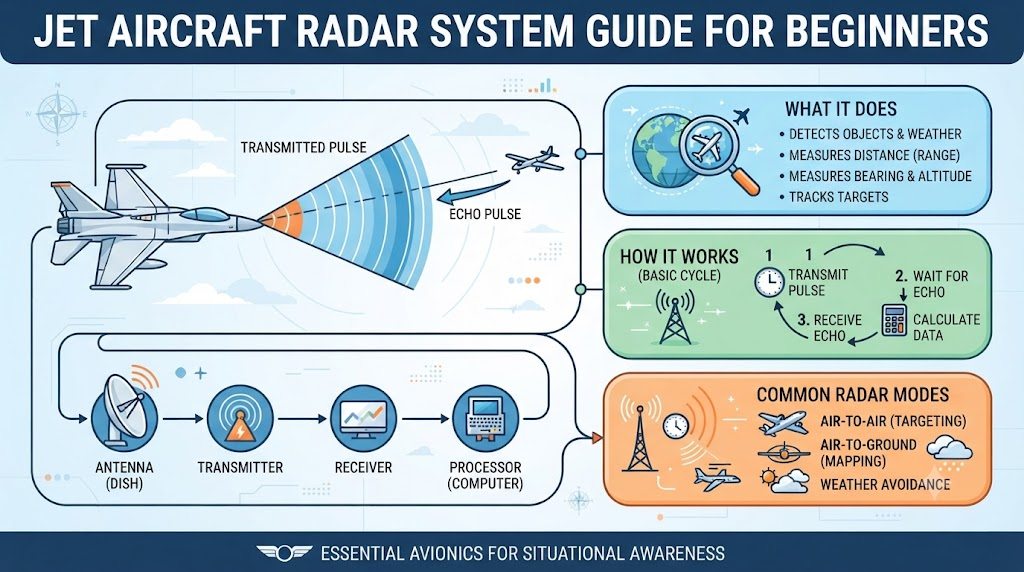
The basic principle is relatively simple. A radar system sends radio-frequency energy outward and receives some of the energy that is reflected back from objects or atmospheric conditions. The system then processes these signals to provide useful information to the flight crew.
Depending on the type of radar, the information may include the approximate location, distance, direction, movement, or intensity of a detected target.
Aircraft radar systems can have different purposes. Weather radar, for example, is primarily designed to help crews identify areas of precipitation and potentially hazardous weather. Other radar technologies can support navigation, surveillance, or broader situational awareness.
How Does Aircraft Radar Work?
The basic operation of radar can be understood through a few simple steps:
- Transmission: The radar system sends radio-frequency energy through an antenna.
- Interaction: The transmitted energy encounters an object, precipitation, terrain, or another detectable feature.
- Reflection: Some of the energy is reflected back toward the aircraft.
- Reception: The radar antenna receives the returning signal.
- Processing: Electronic equipment analyzes the signal.
- Display: Useful information is presented to the flight crew through an appropriate cockpit display.
The amount of time taken for a signal to travel outward and return can help the system estimate distance. The characteristics of the returning signal can also provide information about what the radar is detecting.
Modern systems use sophisticated computers and signal-processing techniques to turn these signals into information that pilots can interpret.
Main Components of a Jet Aircraft Radar System
Although the exact design varies between aircraft and radar types, a typical radar system contains several important components.
Radar Antenna
The antenna transmits radar energy and receives returning signals. In many aircraft systems, the antenna is positioned behind a protective structure called a radome.
Transmitter
The transmitter generates the radio-frequency energy used by the radar system. It is one of the core components responsible for sending radar signals into the surrounding environment.
Receiver
The receiver captures returning radar signals. Because these signals can be much weaker than the original transmitted energy, the receiver must process them carefully.
Signal Processor
The signal processor analyzes the received information and converts it into useful data. Modern digital processing allows radar systems to distinguish and organize large amounts of information efficiently.
Display System
The processed information is presented to the flight crew through cockpit displays. The display helps pilots understand what the radar system is detecting without requiring them to interpret raw electronic signals.
Basic Aircraft Radar Components and Their Functions
| Component | Basic Function | Why It Matters |
|---|---|---|
| Antenna | Sends and receives radar energy | Allows the system to interact with the surrounding environment |
| Transmitter | Produces radar signals | Provides the energy required for detection |
| Receiver | Captures returning signals | Allows the system to collect information |
| Signal Processor | Analyzes radar returns | Converts signals into useful information |
| Display | Presents processed information | Helps pilots interpret radar data |
Types of Radar Used in Jet Aircraft
Different radar systems are designed for different purposes. A beginner should understand that there is no single radar system that performs every aviation-related task.
Weather Radar
Weather radar is one of the best-known types of aircraft radar. It helps flight crews identify areas of precipitation and understand the general distribution and intensity of weather ahead of the aircraft.
Weather radar can be particularly useful when crews are assessing areas of thunderstorms or heavy precipitation. However, radar information must be interpreted correctly and considered together with other weather information.
Airborne Surveillance Radar
Some aircraft use radar technologies to detect and track objects or aircraft in their surrounding environment. Such systems can support situational awareness and, depending on the aircraft and system, other operational functions.
Terrain-Related Radar Applications
Certain radar technologies can contribute to terrain awareness and navigation. However, modern aircraft generally use multiple systems and databases for terrain awareness rather than relying on one radar system alone.
Specialized Military Radar
Military aircraft can use highly specialized radar systems for functions that differ significantly from civilian aviation applications. These systems can involve advanced detection, tracking, navigation, and other mission-specific capabilities.
Weather Radar and Its Role in Flight
Weather radar is particularly important because pilots need to understand weather conditions along and around their intended route.
A weather radar system can detect precipitation by transmitting radio waves and analyzing the energy reflected back from water droplets, ice particles, or other atmospheric features.
The resulting information may help pilots identify areas of stronger precipitation. In appropriate circumstances, this can support decisions about route planning and avoiding hazardous weather.
However, radar does not provide a complete picture of the atmosphere. Areas with little or no detectable precipitation may still contain hazards, and radar information can be affected by factors such as attenuation, range, and the characteristics of the weather being observed.
For this reason, pilots use radar alongside forecasts, weather reports, visual observations, air traffic information, and other available resources.
How Radar Detects Objects and Weather
Radar detection depends on reflected radio-frequency energy.
When radar energy encounters something that can reflect it, some energy returns toward the aircraft. The radar system analyzes that return to determine useful characteristics.
For weather radar, the strength of the return is generally associated with the amount and characteristics of precipitation within the radar beam. Stronger returns can indicate areas of heavier precipitation, although radar colors and intensity information should always be interpreted according to the aircraft’s specific system and operating procedures.
For object detection systems, radar processing can use information from returned signals to help determine characteristics such as range and relative movement.
Understanding Basic Radar Terms
Beginners may encounter several technical terms when studying aircraft radar.
Range
Range refers to the distance between the aircraft and a detected target or area.
Bearing
Bearing describes the direction of a target relative to the aircraft or a specified reference.
Radar Beam
The radar beam is the transmitted energy pattern extending outward from the antenna. Its characteristics influence what the radar can detect.
Radar Return
A radar return is the signal received after transmitted energy interacts with an object or atmospheric feature.
Attenuation
Attenuation refers to the reduction in radar signal strength as energy passes through a medium or encounters certain conditions. Heavy precipitation can significantly affect radar energy and influence what is detected beyond it.
Resolution
Resolution describes how effectively a radar system can distinguish separate features or provide detailed information about detected areas.
How Pilots Interpret Radar Information
Radar does not simply tell pilots what to do. Instead, it provides information that must be interpreted as part of the overall flight picture.
Pilots receive radar information through cockpit displays designed to make complex data easier to understand. They consider factors such as aircraft position, flight path, weather information, altitude, air traffic, and operational procedures.
For example, if weather radar indicates an area of significant precipitation ahead, the flight crew may evaluate whether the route needs to be adjusted. Any decision is made according to applicable procedures, weather information, aircraft capabilities, and the broader operational situation.
This is why understanding the limitations of radar is just as important as understanding its capabilities.
Radar and Flight Safety
Radar can contribute significantly to situational awareness, especially when weather or surrounding traffic needs to be assessed.
Weather radar can help crews identify areas of precipitation and potentially hazardous weather. Other radar systems can provide additional information about the aircraft’s surroundings.
However, radar is only one part of a modern aircraft’s safety and information systems. Pilots also rely on navigation systems, communication with air traffic control, weather information, flight instruments, traffic-awareness technologies, terrain-awareness systems, and established operating procedures.
The safest approach is therefore to treat radar as an important source of information rather than as a standalone solution.
Common Misconceptions About Aircraft Radar
Myth 1: Radar Can Detect Everything
Radar has limitations. Detection depends on factors such as signal characteristics, range, target properties, atmospheric conditions, and system design.
Myth 2: Radar Shows a Perfect Picture
Radar displays are processed representations of detected information. They should not be treated as an exact visual picture of everything around an aircraft.
Myth 3: Strong Radar Returns Always Mean Immediate Danger
A strong radar return can indicate significant precipitation or another detectable feature, but its meaning depends on the specific radar system and circumstances.
Myth 4: Pilots Rely Only on Radar
Pilots use multiple sources of information. Radar is an important tool, but it is not the only source used for flight planning and situational awareness.
Limitations of Aircraft Radar
Understanding limitations is essential for anyone learning about aviation radar.
One limitation is range. Radar cannot provide unlimited detection distance, and the useful range depends on the system and operating conditions.
Another limitation is attenuation. Strong precipitation can weaken radar energy and affect information received from areas farther away.
Radar also has limitations related to beam geometry and resolution. The radar beam does not illuminate the entire surrounding environment equally, and objects or weather outside the relevant coverage may not appear on the display.
Finally, radar information requires proper interpretation. Incorrectly understanding a radar display can lead to poor decisions, which is why pilots receive appropriate training and follow established procedures.
Modern Radar Technology in Jet Aircraft
Modern aircraft radar systems are significantly more sophisticated than early radar technologies.
Digital electronics and advanced signal processing allow systems to process large amounts of information quickly. Modern weather radar may provide improved visualization and features designed to help crews understand weather conditions more effectively.
Some aircraft also integrate information from multiple systems into cockpit displays. This approach can give pilots a broader understanding of their operational environment.
The continuing development of aviation technology focuses on improving detection, processing, reliability, integration, and ease of interpretation while maintaining appropriate safety standards.
Common Radar Types and Their Uses
| Radar Type | Primary Purpose | Typical Use |
| Weather Radar | Detect precipitation and weather patterns | Weather assessment |
| Airborne Surveillance Radar | Detect and monitor objects | Situational awareness and surveillance |
| Specialized Mission Radar | Support mission-specific functions | Certain military or specialized aircraft |
| Terrain-Related Radar Applications | Support environmental or terrain awareness | Navigation and safety applications |
Important Considerations for Beginners
If you are beginning to study jet aircraft radar, focus on understanding the basic principles before trying to learn advanced technical specifications.
First, understand how radio waves are transmitted and reflected. Next, learn how the returning signals are processed and displayed. Once these fundamentals are clear, concepts such as range, bearing, attenuation, resolution, and radar returns become easier to understand.
It is also important to remember that different aircraft may use different radar systems. A system designed for a commercial airliner may have different functions and operating characteristics from a system installed on a military aircraft.
Anyone learning aviation systems should also rely on appropriate training materials, aircraft documentation, and qualified instructors when studying operational procedures.
Frequently Asked Questions
1. What is an aircraft radar system?
An aircraft radar system uses radio-frequency energy to detect and gather information about objects, precipitation, or other features around an aircraft.
2. How does jet aircraft radar work?
Radar transmits radio-frequency energy and receives reflected signals. The system processes these returns and presents useful information to the flight crew.
3. Why do jet aircraft use weather radar?
Weather radar helps flight crews identify areas of precipitation and assess weather conditions that may affect the aircraft’s route.
4. Can aircraft radar detect thunderstorms?
Weather radar can detect precipitation associated with thunderstorms and other weather systems. However, radar information has limitations and should be interpreted together with other weather information.
5. What is radar attenuation?
Radar attenuation is the reduction in radar signal strength as the signal travels through certain materials or atmospheric conditions. Heavy precipitation can cause significant attenuation.
6. Does aircraft radar show everything around the aircraft?
No. Radar has limitations related to range, coverage, beam characteristics, target properties, atmospheric conditions, and system design.
7. What is a radar return?
A radar return is the signal received after transmitted radar energy interacts with an object or atmospheric feature and is reflected back toward the radar system.
8. Do pilots rely only on radar for flight safety?
No. Pilots use radar together with flight instruments, weather information, navigation systems, communications, traffic information, procedures, and other aircraft systems.
9. Is aircraft radar difficult for beginners to understand?
The advanced technology can be complex, but the basic concept is relatively straightforward. Learning how radar transmits, receives, processes, and displays information provides a good foundation.
10. Why is learning about radar useful for aviation students?
Understanding radar helps aviation students develop a better knowledge of aircraft systems, weather awareness, situational awareness, and the technologies used in modern flight operations.
Conclusion
Jet aircraft radar systems play an important role in modern aviation by helping crews gather information about weather, objects, and the surrounding environment. Although the technology behind radar can be highly sophisticated, its basic principle is easier to understand when broken into simple steps: transmit, receive, process, and display.
For beginners, the most important lesson is that radar is a valuable information source rather than an infallible picture of the environment. Understanding its capabilities, limitations, and proper interpretation provides a stronger foundation for learning about aircraft systems and aviation safety.
