
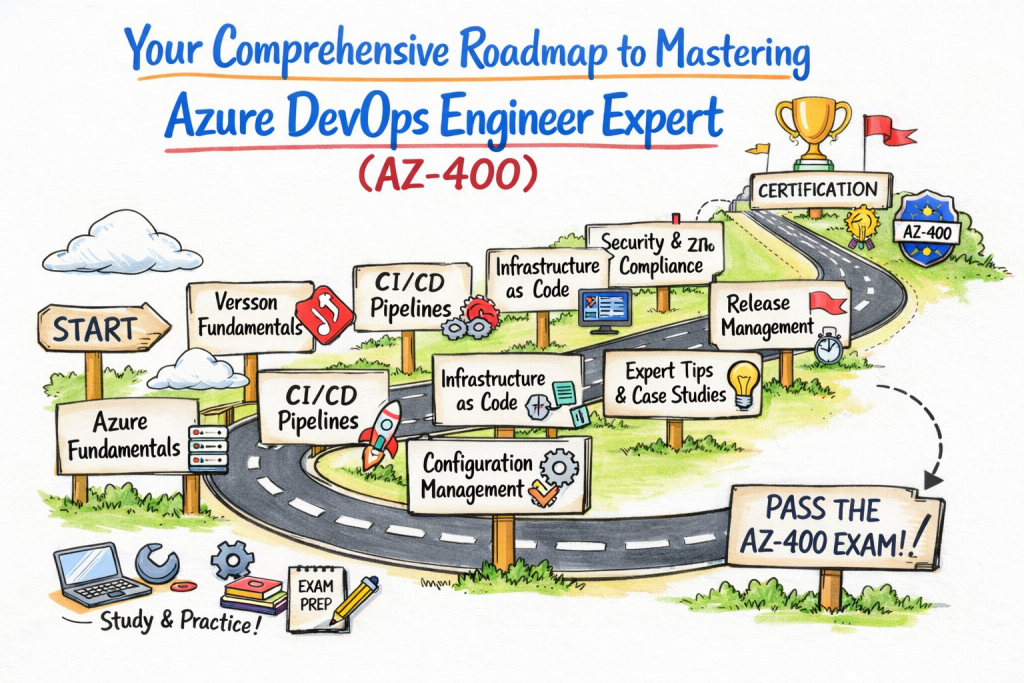
In my decades of navigating the software development and infrastructure landscape, I’ve witnessed firsthand the transformative power of DevOps. It’s more than just a set of tools; it’s a cultural shift that bridges the gap between development and operations. The Azure DevOps Engineer Expert (AZ-400) certification is the gold standard for professionals looking to validate their expertise in this critical discipline. This guide, drawn from years of battle-tested experience, is designed to give you a complete, no-nonsense roadmap to understanding and achieving this certification.
What is the Azure DevOps Engineer Expert (AZ-400) Certification?
What It Is
The Azure DevOps Engineer Expert (AZ-400) is an expert-level credential from Microsoft that validates your skills in combining people, processes, and technologies to deliver continuous value. It focuses on designing and implementing DevOps strategies for collaboration, code, infrastructure, source control, security, compliance, continuous integration, testing, delivery, monitoring, and feedback using Microsoft technologies like Azure DevOps and GitHub .
Who Should Take It
This certification is designed for experienced DevOps engineers who are either developers or infrastructure administrators. You are the subject matter expert who works with cross-functional teams—including developers, site reliability engineers (SREs), Azure administrators, and security engineers—to enable continuous delivery in an organization . It’s for those who not only understand the tools but also the cultural and process changes needed for successful DevOps adoption.
Skills You’ll Gain
After earning this certification, you’ll possess a robust skillset, including the ability to:
- Design and implement processes and communication strategies across teams.
- Design and implement a source control strategy (think branching, merging, and Git at scale).
- Design and implement build and release pipelines, which is the core of CI/CD.
- Develop a security and compliance plan (shifting security left).
- Implement an instrumentation strategy for monitoring and feedback .
Real-World Projects You Should Be Able to Do After It
Post-certification, you’re not just a theorist. You should be able to lead or execute projects such as:
- Migrating a legacy .NET application from on-premises servers to Azure Kubernetes Service (AKS) using Azure Pipelines for CI/CD.
- Implementing a comprehensive branch policy in GitHub that requires successful builds and at least one reviewer for all pull requests to the main branch.
- Setting up a canary deployment strategy for a microservices-based application to minimize the blast radius of a bad release.
- Integrating security scanning tools like SonarQube and dependency checkers directly into your build pipeline to automatically fail a build if vulnerabilities are found.
- Designing a real-time dashboard in Azure Dashboards or Power BI that visualizes key DevOps metrics like deployment frequency, lead time, and mean time to recover (MTTR).
Your Preparation Plan for AZ-400
The time you need depends entirely on your existing experience. Someone living and breathing Azure and CI/CD will need less time than someone newer to the ecosystem. Here’s a realistic breakdown based on what I’ve seen work for countless professionals.
7–14 Days (The Cram Session)
This is for seasoned Azure pros who just need to brush up on exam objectives.
- Focus: High-level overview of the official Microsoft Learn modules for AZ-400.
- Activities: Review the “Skills measured” section, take the official practice assessments on Microsoft Learn, and identify weak spots. Spend time only on those weak areas .
- Goal: Assess readiness and fill specific knowledge gaps.
30 Days (The Structured Approach)
This is the sweet spot for most engineers with some Azure and CI/CD experience.
- Week 1: Cover the fundamentals. Focus on source control strategies, branching models (GitHub Flow, Git Flow), and setting up Azure Repos and GitHub.
- Week 2: Dive deep into Azure Pipelines. Build YAML pipelines from scratch, explore variables, templates, and jobs. Implement CI.
- Week 3: Master Continuous Delivery. Learn about release strategies (blue-green, canary), deployment gates, and service connections.
- Week 4: Tackle security, compliance, and monitoring. Focus on Key Vault integration, Azure Policy, and Application Insights. Take practice exams .
60 Days (The Comprehensive Journey)
Ideal for those who are newer to DevOps practices or need more hands-on time.
- Month 1: Combine the “30 Days” plan but spread it out. Spend two weeks on source control and CI pipeline fundamentals. Spend two weeks on CD strategies and Infrastructure as Code (ARM, Bicep, Terraform).
- Month 2: Dedicate the first two weeks to advanced topics: container strategies (AKS, Docker), security scanning, and compliance. Use the final two weeks to build a complete end-to-end project and take multiple practice exams to build confidence.
Common Mistakes Candidates Make
- Ignoring the Prerequisites: The biggest mistake is trying to tackle AZ-400 without first earning your Azure Administrator (AZ-104) or Azure Developer (AZ-204) associate certification. The expert exam builds directly upon that knowledge .
- Focusing Only on Theory: You can’t pass this exam by just reading documentation. You must have hands-on experience creating build pipelines, setting up branch policies, and configuring monitoring. Use a free Azure subscription to practice relentlessly.
- Underestimating YAML: The exam heavily emphasizes YAML-based pipelines over the classic visual designer. Be comfortable writing and understanding complex YAML code.
- Neglecting GitHub: While Azure DevOps is core, the modern exam also covers GitHub Actions, GitHub Projects, and GitHub authentication methods. Don’t skip this .
- Using “Brain Dumps”: This is a fast track to getting your certification permanently revoked by Microsoft. More importantly, it robs you of the genuine learning and competence the certification is meant to represent. Trust me, the real-world knowledge is worth far more than a piece of paper .
Best Next Certification After This
Once you’ve conquered the DevOps Engineer Expert certification, your next step depends on your career trajectory.
- Same Track (Deepening Expertise): Microsoft Certified: Cybersecurity Architect Expert (SC-100) . This is a natural progression, allowing you to apply your DevOps security knowledge (DevSecOps) at an architectural level.
- Cross-Track (Broadening Skills): AWS Certified DevOps Engineer – Professional. This demonstrates your ability to apply DevOps principles across multiple cloud platforms, making you an incredibly valuable asset.
- Leadership Track (Strategic View): Certified Kubernetes Administrator (CKA) . While technical, mastering Kubernetes orchestration is a key skill for leading platform engineering teams and building modern infrastructure .
Choose Your Path: Aligning Certifications with Modern Practices
Choose Your Path: Aligning Certifications with Modern Practices
The Azure DevOps Engineer Expert (AZ-400) certification isn’t a destination—it’s a launchpad. The principles it covers form the foundation for virtually every modern engineering practice. But depending on where you want to specialize, your next steps will look very different.
Here’s how the core AZ-400 domains map to six key disciplines.
DevOps Path
The Core Discipline
You own the entire software delivery lifecycle—from commit to production. You break down silos between dev and ops. Your mantra: automate everything.
AZ-400 focus: Build/release pipelines, source control, dependency management.
Next: Master GitHub Actions, Azure Artifacts, Test Plans.
DevSecOps Path
Security at Speed
Security built in from the start, not bolted on at the end. Vulnerabilities fail the build. Compliance is automated. Security never becomes a bottleneck.
AZ-400 focus: Security/compliance plans, pipeline security tools, Key Vault integration.
Next: SC-100 Cybersecurity Architect, Certified DevSecOps Professional.
SRE Path
Reliability as a Feature
You treat operations as a software problem. SLOs, error budgets, self-healing systems. You’d rather build systems that don’t wake you up at 3 AM.
AZ-400 focus: Instrumentation strategy, failure design, feedback loops.
Next: CKA, Azure Monitor deep dive, Chaos Engineering.
AIOps/MLOps Path
Intelligent Ops + ML Pipelines
You deploy models that learn and evolve. Versioning for datasets. Automated retraining. Using AI to detect anomalies before they become incidents.
AZ-400 focus: CI/CD for ML workflows, monitoring for model drift.
Next: DP-100 Data Scientist, AI-102 AI Engineer, MLOps specializations.
DataOps Path
Data Pipeline Reliability
Version control for schemas. Automated data testing. CI/CD for ETL. Your data pipelines are as reliable as your app deployments.
AZ-400 focus: Source control for data, pipelines for data jobs, data quality monitoring.
Next: DP-203 Data Engineer, dbt certifications.
FinOps Path
Cloud Cost Optimization
You bring financial accountability to cloud spend. Tagging for cost allocation. Policies to prevent runaway spending. Engineering teams see what their architecture choices cost.
AZ-400 focus: IaC for cost governance, cost monitoring/analytics.
Next: FinOps Certified Practitioner, Azure Cost Management.
Role → Recommended Certifications Mapping
| Your Role | Primary Certification | Complementary Certifications/Skills |
|---|---|---|
| DevOps Engineer | Azure DevOps Engineer Expert (AZ-400) | Azure Developer (AZ-204) |
| SRE | Azure DevOps Engineer Expert (AZ-400) | Azure Monitor, Chaos Studio, Kubernetes (AKS) |
| Platform Engineer | Azure DevOps Engineer Expert (AZ-400) | Azure Administrator (AZ-104), Terraform, AKS |
| Cloud Engineer | Azure Administrator (AZ-104) | Azure DevOps Engineer Expert (AZ-400) for automation |
| Security Engineer | Security Engineer (SC-200) or Cybersecurity Architect (SC-100) | AZ-400 (for DevSecOps practices) |
| Data Engineer | Azure Data Engineer (DP-203) | AZ-400 (to operationalize data pipelines) |
| FinOps Practitioner | FinOps Certified Practitioner | AZ-400 (for cost governance via IaC) |
| Engineering Manager | Azure DevOps Engineer Expert (AZ-400) | Azure Fundamentals (AZ-900), Scrum/Agile certifications |
Top Institutions for AZ-400 Training
Several excellent institutions provide structured training to help you prepare for the AZ-400 exam. Here are a few with proven track records:
- DevOpsSchool
DevOpsSchool offers comprehensive, instructor-led training programs for AZ-400. Their curriculum is designed by industry experts and focuses heavily on hands-on labs and real-world scenarios, ensuring you gain practical experience alongside theoretical knowledge. - Cotocus
Cotocus provides personalized training and mentoring for the Azure DevOps Engineer Expert certification. They are known for their flexible learning approaches, including customized corporate training and one-on-one coaching sessions tailored to individual skill gaps. - Scmgalaxy
Scmgalaxy is a well-known platform for DevOps and SCM training. Their AZ-400 course typically covers the entire exam syllabus with a strong emphasis on configuration management, CI/CD pipeline creation, and the integration of various DevOps tools with Azure. - BestDevOps
True to its name, BestDevOps focuses on delivering high-quality DevOps education. Their AZ-400 preparation course is structured to take students from foundational concepts to expert-level proficiency, with a strong focus on practical labs. - devsecopsschool.com
As a specialized offshoot, this site focuses on the crucial intersection of development, security, and operations. Their AZ-400 training integrates security scanning, compliance, and secure pipeline practices, making it ideal for those targeting DevSecOps roles. - sreschool.com
This institution specializes in Site Reliability Engineering principles. Their approach to AZ-400 is often filtered through an SRE lens, focusing heavily on the monitoring, instrumentation, and feedback-loop aspects of the exam, which are critical for reliability. - aiopsschool.com
AIOpsSchool focuses on the future of IT operations—artificial intelligence. Their AZ-400 training helps you understand how to build pipelines that can feed into AI models for predictive analytics and anomaly detection, blending traditional DevOps with AI-driven operations. - dataopsschool.com
DataOpsSchool tailors its AZ-400 training for data professionals. They emphasize how to apply DevOps principles to data pipelines, covering topics like versioning data schemas, automating data testing, and deploying analytics solutions with Azure DevOps. - finopsschool.com
FinOpsSchool addresses the growing need for cloud financial management. Their AZ-400 curriculum includes modules on implementing cost controls through infrastructure-as-code, using tagging strategies for cost allocation, and automating policies to prevent cloud waste.
Frequently Asked Questions (FAQs)
- How difficult is the AZ-400 exam?
It’s considered an expert-level exam, so it’s challenging. The difficulty is moderate to high, especially if you lack hands-on experience. It’s not just about memorizing facts; it tests your ability to make architectural decisions and design solutions . - How much time do I need to prepare for AZ-400?
For most working professionals with some Azure experience, a dedicated 4-8 weeks of consistent study (10-15 hours per week) is a realistic timeframe. If you’re new to Azure, you should first pursue the associate-level prerequisites, which will add significant time . - What are the exact prerequisites for AZ-400?
To earn the DevOps Engineer Expert certification, you must first earn either the Azure Administrator Associate (AZ-104) or the Azure Developer Associate (AZ-204) certification. You don’t have to take them in a specific order, but both are required before Microsoft will grant you the expert-level title . - Should I take AZ-104 or AZ-204 before AZ-400?
It depends on your background. If you are more infrastructure-focused (networks, VMs, storage), take AZ-104. If you are more development-focused (coding, app deployment), take AZ-204. Both provide the foundational Azure knowledge you’ll need for AZ-400. - What is the value of the AZ-400 certification for my career?
It’s incredibly valuable. It validates your ability to lead DevOps transformations, making you a top candidate for senior engineering roles. It often leads to higher salary brackets and greater professional credibility, as it demonstrates a mastery of modern software delivery practices . - What are the career outcomes after becoming an Azure DevOps Engineer Expert?
You’ll be qualified for roles such as DevOps Engineer, Lead DevOps Engineer, Cloud Automation Engineer, Site Reliability Engineer (SRE), and Platform Engineer. It’s a certification that opens doors to both technical leadership and individual contributor growth paths. - Is the AZ-400 exam mostly about Azure Pipelines?
While CI/CD (build and release pipelines) is the largest single domain, making up about 50% of the exam, the other half covers critical topics like source control, security, and instrumentation. It’s a balanced test of the entire DevOps lifecycle . - Does the AZ-400 exam cover GitHub?
Yes, absolutely. The exam objectives include designing and implementing processes using both Azure DevOps and GitHub. Expect questions on GitHub Actions, GitHub Projects, branch protection rules, and authentication methods . - What is the passing score for AZ-400?
The passing score is 700 out of 1000 . - How long is the AZ-400 certification valid for?
Microsoft’s role-based and specialty certifications, including the DevOps Engineer Expert, are valid for one year. You can renew it for free by passing a renewal assessment on Microsoft Learn within six months of your certification expiry date . - Does the exam require knowledge of Infrastructure as Code (IaC) tools?
Yes. You need to be familiar with IaC concepts and tools, including ARM templates, Bicep, and even third-party tools like Terraform, and how they fit into a CI/CD pipeline . - What is the best order to take the exams?
The most logical path is to first obtain your associate-level certification (AZ-104 or AZ-204). Once you have that foundation, then focus on preparing for and passing the AZ-400 exam.
Conclusion
Earning the Azure DevOps Engineer Expert (AZ-400) certification is more than just a credential—it’s proof that you’ve mastered the core discipline driving modern software delivery. From my years in this field, I’ve seen firsthand that organizations succeed or fail based on how well they bridge the gap between development and operations. This certification validates that you understand not just the tools, but the culture, the automation, and the reliability practices that separate high-performing teams from the rest. Whether you specialize in DevSecOps, SRE, MLOps, or FinOps, AZ-400 gives you the foundation to build upon. The cloud will keep evolving, but the principles you’ve learned—continuous delivery, infrastructure as code, security shift-left, and feedback-driven improvement—will serve you for your entire career. Now go build something amazing.