
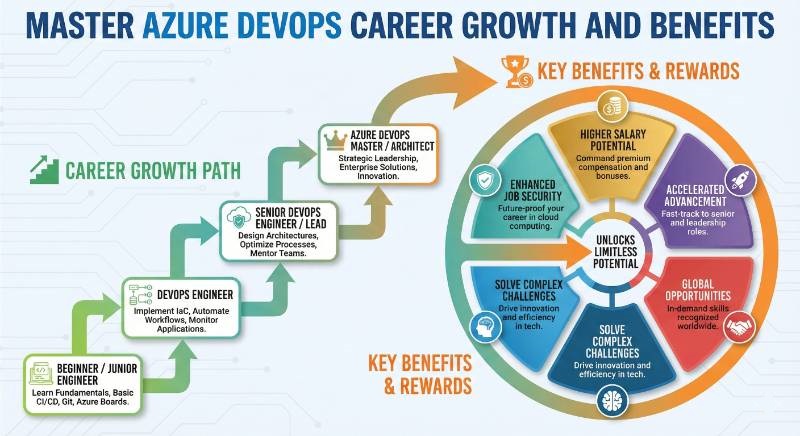
The landscape of software delivery has shifted. We are no longer in an era where “writing code” is enough. Today, the competitive advantage of any organization—from a startup in Bangalore to a Fortune 500 firm in New York—lies in its engineering velocity and operational resilience.
As someone who has navigated the evolution from manual bash scripts and physical racked servers to the sophisticated, AI-driven cloud ecosystems of today, I have seen many tools come and go. However, Azure DevOps has emerged as a powerhouse. It isn’t just a CI/CD tool; it is a holistic philosophy of collaboration, security, and efficiency.
Whether you are an engineer looking to future-proof your career or a manager aiming to streamline your team’s delivery, this guide is your roadmap to professional excellence through the Master in Azure DevOps certification.
What is the Master in Azure DevOps Certification?
In a market saturated with “introductory” courses, the Master in Azure DevOps stands out because it focuses on end-to-end orchestration. It is designed to move you beyond simple task automation and into the realm of architectural design and strategic implementation.
What it is
This is a comprehensive, high-level certification program that validates an engineer’s ability to design and implement strategies for collaboration, code, infrastructure, source control, security, compliance, continuous integration, testing, delivery, monitoring, and feedback using Azure technologies.
Who should take it
- Senior Software Engineers wanting to lead DevOps transformations.
- System Administrators transitioning into Cloud/Site Reliability Engineering.
- Technical Leads and Managers who need to oversee complex delivery pipelines.
- Architects designing scalable, secure cloud-native applications.
Skills you’ll gain
- Advanced CI/CD Pipeline Design: Designing multi-stage YAML pipelines with gates and approvals.
- Infrastructure as Code (IaC): Mastering Terraform, Bicep, and ARM templates for repeatable environments.
- Security Integration (DevSecOps): Implementing automated vulnerability scanning and compliance as code.
- Site Reliability Engineering (SRE) Principles: Managing SLIs, SLOs, and error budgets within the Azure ecosystem.
- Dependency Management: Creating and managing private package feeds (NuGet, npm, Python).
Real-world projects you should be able to do after it
- Blue/Green & Canary Deployments: Execute zero-downtime deployments for high-traffic applications.
- Self-Healing Infrastructure: Build automated remediation workflows using Azure Monitor and Logic Apps.
- Governance at Scale: Implement Azure Policies to ensure cost control and regional compliance across 100+ subscriptions.
Preparation Plan
- 7–14 Days (The Fast Track): Ideal if you already use Azure DevOps daily. Focus on the nuances of Service Connections, Project Settings, and advanced YAML syntax.
- 30 Days (The Standard Path): Recommended for most engineers. Spend 1 hour daily on documentation and 2 hours on hands-on labs (building real pipelines).
- 60 Days (The Deep Dive): For those new to the Azure ecosystem. Start with Azure fundamentals before moving into the specifics of Boards, Repos, and Pipelines.
Common Mistakes
- Ignoring the “Culture” Aspect: DevOps is 80% people and 20% tools. Don’t focus solely on the YAML; understand the feedback loops.
- Skipping Security: Many treat security as an afterthought. In this program, “shifting left” is a core requirement.
- Over-complicating Pipelines: Beginners often build “spaghetti” pipelines. Masters focus on modularity and reusable templates.
Best next certification after this
Once you have mastered the “how” of Azure DevOps, the natural next step is mastering the “what” of the architecture. I recommend moving toward Azure Solutions Architect Expert to understand the broader cloud fabric your pipelines are feeding.
Azure DevOps Certification Matrix
| Track | Level | Who it’s for | Prerequisites | Skills Covered | Recommended Order |
| DevOps | Master | Engineers & Architects | Basic Cloud Knowledge | CI/CD, IaC, GitOps, Monitoring | 1 |
| Security | Advanced | Security Engineers | DevOps Foundations | SAST/DAST, Compliance, Secrets | 2 |
| DataOps | Advanced | Data Engineers | Data Fundamentals | Data Pipelines, Schema Versioning | 2 |
Choose Your Path: 6 Specialized Learning Journeys
The beauty of a 20-year career is realizing that “DevOps” is an umbrella, not a silo. Depending on your interest, you can pivot your Azure DevOps mastery into these specialized paths:
1. The DevOps Path
The classic route. You focus on the “Inner Loop” (coding, testing) and the “Outer Loop” (release, monitoring). You become the bridge between development and operations.
2. The DevSecOps Path
Focuses on security-as-code. You integrate tools like SonarQube, Mend, and Azure Key Vault directly into the pipeline so that security is never a bottleneck.
3. The SRE Path
The “Engineer’s approach to Operations.” You focus on reliability, scalability, and performance. You use Azure Monitor and Application Insights to ensure 99.99% uptime.
4. The AIOps/MLOps Path
The future of the industry. You manage the lifecycle of Machine Learning models. You build pipelines that don’t just deploy code, but also retrain and redeploy models based on data drift.
5. The DataOps Path
Applying DevOps rigor to data analytics. You ensure that data pipelines are versioned, tested, and deployed with the same reliability as a web application.
6. The FinOps Path
The “Cloud Financial Management” path. You use Azure Cost Management and DevOps tagging strategies to ensure the cloud bill doesn’t spiral out of control while maximizing value.
Role → Recommended Certifications Mapping
If you are currently in one of these roles, here is how you should prioritize your learning:
- DevOps Engineer: Master in Azure DevOps → Azure Security Engineer.
- SRE: Master in Azure DevOps → Azure Monitor Specialist.
- Platform Engineer: Master in Azure DevOps → Kubernetes Service (AKS) Expert.
- Cloud Engineer: Azure Administrator → Master in Azure DevOps.
- Security Engineer: Master in Azure DevOps → Azure Security Technologies.
- Data Engineer: Azure Data Engineer → Master in Azure DevOps (DataOps focus).
- FinOps Practitioner: Master in Azure DevOps → Azure Cost Management.
- Engineering Manager: Master in Azure DevOps (Overview) → Agile/Scrum Master.
Top Training Institutions for Master in Azure DevOps
Here’s a concise overview of leading institutions that provide strong support for mastering Azure DevOps through hands-on training, real projects, and certification guidance.
DevOpsSchool
Offers structured Azure DevOps training with live sessions, practical labs, and real-world project exposure. Strong focus on CI/CD, IaC, containers, monitoring, and certification readiness.
Cotocus
Enterprise-focused training with real deployment scenarios. Emphasizes practical DevOps workflows and cloud implementation strategies.
ScmGalaxy
Specializes in CI/CD, Git, automation, and configuration management. Builds strong core DevOps foundations aligned with Azure environments.
BestDevOps
Provides scenario-based learning covering pipelines, automation, release management, and enterprise DevOps practices.
DevSecOpsSchool
Focused on integrating security into DevOps pipelines. Ideal for professionals who want to combine Azure DevOps with DevSecOps practices.
SRESchool
Offers training in reliability engineering, monitoring, and incident management — essential for advanced Azure DevOps professionals.
AIOpsSchool
Covers AI-driven operations and intelligent monitoring, complementing modern Azure DevOps implementations.
DataOpsSchool
Focuses on automating data pipelines and analytics workflows, useful for DevOps professionals working with data platforms.
FinOpsSchool
Specializes in cloud cost governance and optimization — an important skill for managing Azure environments at scale.
These institutions help professionals move beyond theory into practical, enterprise-ready Azure DevOps expertise.
Next Certifications to Take
Once you have achieved your Master in Azure DevOps, don’t stop. The industry evolves every six months.
- Same Track (Deepening): Azure Solutions Architect Expert. This solidifies your understanding of the underlying infrastructure you are automating.
- Cross-Track (Broadening): Certified Kubernetes Administrator (CKA). Azure DevOps and Kubernetes are the “dynamic duo” of modern engineering.
- Leadership (Growth): ITIL 4 Leader or Digital & IT Strategy. If you want to move into Director or VP of Engineering roles, you need to understand the service management side of the house.
FAQs
1. Is the Master in Azure DevOps certification difficult?
It is challenging because it requires a mindset shift from “running commands” to “designing systems.” However, with the 30-day preparation plan mentioned above, it is highly achievable for any dedicated engineer.
2. How much time do I need to invest?
On average, 40 to 60 hours of focused study and lab work is sufficient for an experienced engineer to feel confident.
3. Are there any prerequisites?
While there are no hard barriers to entry, having a basic understanding of Cloud Computing and Version Control (Git) will make your journey much smoother.
4. In what sequence should I take the modules?
Start with Azure Boards (Planning), move to Repos (Source Control), then Pipelines (CI/CD), and finish with Test Plans and Artifacts.
5. What is the career value of this certification?
In the current market, “DevOps” is one of the highest-paying skill sets. This certification acts as a badge of trust for recruiters and hiring managers.
6. Will this help me get a job in India vs. Global?
Yes. Azure has a massive footprint in both the Indian enterprise sector and the global SaaS market. The skills are universal.
7. How often does the curriculum change?
Azure updates its features frequently. The Master program is designed to be “evergreen,” focusing on core principles while updating specific tool features every few months.
8. Can I pass without hands-on experience?
It is very difficult. This certification values the “how” over the “what.” You must spend time in the Azure portal and writing YAML.
9. Does it cover DevSecOps?
Yes, security is a core pillar of the Master program, covering everything from secret management to automated scanning.
10. Is it worth it for Managers?
Absolutely. Managers need to understand the “Art of the Possible” to set realistic deadlines and build efficient team structures.
11. What is the pass percentage?
Typically, you need a 700/1000 score or equivalent depending on the specific module evaluation.
12. How does this compare to AWS DevOps?
While the tools differ, the principles (CI/CD, IaC) are the same. Azure DevOps is often preferred in corporate and enterprise environments due to its superior integration with the Microsoft ecosystem.
FAQs – Master in Azure DevOps
1. Is Master in Azure DevOps suitable for beginners?
It is recommended for professionals who already understand basic DevOps and Azure concepts. Beginners should start with foundational certifications first.
2. How difficult is the certification?
It is advanced but manageable if you have hands-on experience with CI/CD, cloud deployments, and automation.
3. How much time is required to prepare?
Working professionals typically need 30–60 days depending on their experience level and daily study time.
4. Do I need coding knowledge?
Basic scripting knowledge (PowerShell, Bash, or Python) is helpful but deep programming expertise is not mandatory.
5. What prerequisites should I have?
You should understand Git, CI/CD basics, Azure fundamentals, and infrastructure concepts before starting.
6. Does it include Kubernetes and containers?
Yes, containerization and Azure Kubernetes Service (AKS) concepts are part of advanced Azure DevOps practices.
7. Is this certification valuable globally?
Yes. Azure DevOps is widely adopted across enterprises worldwide, making the certification globally relevant.
8. Can it help me switch from AWS to Azure?
Yes. DevOps principles remain the same; you will mainly learn Azure-specific implementations.
Conclusion
Master in Azure DevOps is more than a certification — it is a career transformation step. In today’s cloud-driven engineering world, organizations need professionals who can design secure, automated, scalable, and cost-efficient delivery systems on Azure. This program equips you with those capabilities.
If you are already working in DevOps, cloud, or platform engineering, this certification helps you move from execution to architecture-level thinking. It strengthens your understanding of CI/CD, infrastructure as code, containers, governance, and security integration within Azure environments.