
Introduction
The cloud landscape has changed significantly over the decades. What used to be simple server hosting has evolved into a complex ecosystem of automated services, smart data handling, and tight security. Today, being a cloud engineer is about more than just knowing how to click buttons in a console; it is about building systems that are resilient, cost-effective, and fast.
Google Cloud Platform (GCP) stands out because it brings the same infrastructure that powers Google to your fingertips. This guide is designed to help you navigate the path to becoming a Google Cloud Professional Engineer. Whether you are an engineer on the ground or a manager leading a team, understanding these certifications is the key to mastering the modern cloud.
Google Cloud Professional Engineer: The Master Certification
What it is
The Google Cloud Professional Engineer certification is a high-level credential that proves you can design, develop, and manage robust, secure, and scalable solutions. It focuses on using Google Cloud technologies to solve complex business problems while ensuring operational excellence.
Who should take it
This is built for professionals who already have a solid footing in cloud architecture or development. It is ideal for Software Engineers, Cloud Architects, and DevOps leads who want to demonstrate their ability to handle large-scale enterprise environments.
Skills you’ll gain
- Designing for high availability and disaster recovery.
- Managing and provisioning cloud solution infrastructure.
- Ensuring security and compliance across all cloud layers.
- Optimizing network performance and latency.
- Automating deployment pipelines and operational tasks.
Real-world projects you should be able to do
- Migrating a massive on-premise monolith to a microservices architecture on GKE.
- Setting up a global multi-region network with private connectivity.
- Implementing a fully automated CI/CD pipeline with built-in security scanning.
- Building a scalable data processing engine using Pub/Sub and Dataflow.
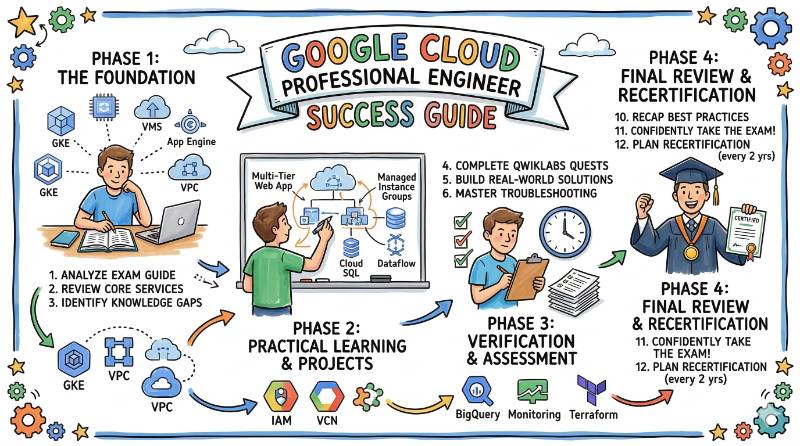
Preparation plan
The 14-Day “Fast Track” (For GCP Power Users)
This is for engineers who are already working in the Google Cloud Console every day.
- Days 1–4: Focus on the “Google Way” of networking. Review Shared VPCs, Cloud Armor policies, and Load Balancing nuances.
- Days 5–8: Deep dive into the CLI. Practice complex
gcloud,gsutil, andbqcommands. You will be tested on specific syntax. - Days 9–12: Review the official case studies. These are long stories about fictional companies—understand their pain points and Google’s recommended solutions.
- Days 13–14: Take 2–3 full-length practice exams to build your “exam stamina.”
The 30-Day “Standard Path” (For Experienced Engineers)
This is the most common path for Software Engineers and Managers transitioning to GCP.
- Week 1: Core Infrastructure. Master Compute Engine, GKE (Kubernetes), and App Engine. Know when to use which.
- Week 2: Data & Storage. Understand the difference between Cloud SQL, Spanner, Bigtable, and Firestore. This is where many people lose marks.
- Week 3: Security & Operations. Focus on IAM (Identity and Access Management) roles, service accounts, and Cloud Monitoring (Stackdriver).
- Week 4: Hands-on Labs & Case Studies. Use Qwiklabs or the Google Free Tier to build small projects. Re-read the case studies three times.
The 60-Day “Deep Dive” (For Beginners or Managers)
If you are coming from a non-cloud background or a different provider (like AWS), take your time to learn the philosophy of GCP.
- Days 1–20: Foundations. Start with the Associate Cloud Engineer material. Even if you don’t take that exam, the knowledge is vital.
- Days 21–40: Service Deep Dives. Spend 2–3 days on each major service. Build a VPC, set up a database, and deploy a containerized app.
- Days 41–50: Architecture & Best Practices. Read the “Google Cloud Architecture Framework.” Focus on reliability and cost-optimization.
- Days 51–60: Review & Practice. Focus on your weak areas identified during practice tests.
Common mistakes
- Ignoring the command line; many questions require knowledge of specific
gcloudorgsutilcommands. - Underestimating networking; Google’s VPC and Load Balancing work differently than other providers.
- Focusing only on “how” and not “why”; the exam tests your architectural decision-making.
Best next certification after this
Once you have mastered the engineering side of Google Cloud, your next step depends on whether you want to go deeper, wider, or higher into leadership.
1. The Deep-Dive Path (Specialization)
- Certification: Certified Kubernetes Administrator (CKA).
- Focus: Since GKE is a core part of Google Cloud, mastering Kubernetes at the administration level makes you an elite technical expert. It is the best move for those wanting to dominate the DevOps and SRE space.
2. The Broad-Expert Path (Cross-Track)
- Certification: Google Cloud Professional Data Engineer.
- Focus: Modern systems are built on data. Moving into this track allows you to manage massive data pipelines (BigQuery, Dataflow) and bridges the gap between infrastructure and data science.
3. The Leadership Path (Strategy)
- Certification: Google Cloud Professional Cloud Architect.
- Focus: This is the natural progression for managers and senior leads. It shifts the focus from “how to build” to “designing business solutions,” covering compliance, high-level architecture, and cost strategy.
Google Cloud Certification Landscape
Planning your journey requires a clear view of the options. Below is a detailed breakdown of the tracks available for professionals today.
| Track | Level | Who it’s for | Prerequisites | Skills Covered | Recommended Order |
| Cloud DevOps | Professional | DevOps & SREs | 3+ years experience | Automation, CI/CD, SRE principles, Monitoring | After Associate Cloud Engineer |
| Cloud Architect | Professional | Solutions Architects | 3+ years experience | Design, Management, Security, Compliance | After Associate Cloud Engineer |
| Cloud Developer | Professional | App Developers | 3+ years experience | Cloud-native apps, APIs, Debugging | After Associate Cloud Engineer |
| Data Engineer | Professional | Data Scientists | 3+ years experience | Big data, ML, Data processing | After Associate Cloud Engineer |
| Security Engineer | Professional | Security Ops | 3+ years experience | IAM, Encryption, Network Security | After Professional Architect |
| Network Engineer | Professional | Network Admins | 3+ years experience | VPCs, Interconnect, DNS, Firewalls | After Professional Architect |
Choose Your Path: 6 Specialized Tracks
The cloud is no longer a “one-size-fits-all” domain. Depending on your career goals, you should follow a specific path:
- DevOps Path:
Focuses on the speed of delivery. You will learn to bridge the gap between development and operations using automation. - DevSecOps Path:
This is DevOps with security baked in. It is for those who believe security should be part of the code, not an afterthought. - SRE Path:
Site Reliability Engineering is about applying software engineering mindsets to system administration. It focuses on uptime and scalability. - AIOps/MLOps Path:
This path is for those managing the lifecycle of machine learning models. It ensures that AI is not just built, but deployed and monitored correctly. - DataOps Path:
Focused on the flow of data. You will learn how to manage data pipelines so that they are reliable and accessible for business intelligence. - FinOps Path:
The cloud can be expensive. This path is for those who want to master cloud financial management and cost optimization.
Role → Recommended Certifications Mapping
To make it easier for managers and engineers to plan, here is the recommended mapping:
- DevOps Engineer: Associate Cloud Engineer → Professional Cloud DevOps Engineer.
- SRE: Associate Cloud Engineer → Professional Cloud DevOps Engineer → Professional Cloud Network Engineer.
- Platform Engineer: Associate Cloud Engineer → Professional Cloud Architect.
- Cloud Engineer: Associate Cloud Engineer → Professional Cloud Architect.
- Security Engineer: Associate Cloud Engineer → Professional Cloud Security Engineer.
- Data Engineer: Associate Cloud Engineer → Professional Data Engineer.
- FinOps Practitioner: Associate Cloud Engineer → Professional Cloud Architect.
- Engineering Manager: Associate Cloud Engineer → Professional Cloud Architect.
Next steps: Expanding Your Knowledge
After completing your Google Cloud Professional Engineer journey, you should look toward expanding your portfolio. According to industry standards, engineers should look at three main directions for growth:
- Same Track: Deepen your expertise in DevOps by taking specialized courses in Kubernetes (CKAD/CKA) to complement your Google Cloud skills.
- Cross-Track: If you are a DevOps expert, look toward the Professional Data Engineer track. Understanding how data moves is vital for modern app scaling.
- Leadership: Transition into the Professional Cloud Architect role. This shifts your focus from “how to build” to “what should be built” for the business.
Top Institutions for Training and Certification
Choosing the right training partner is essential for success. These institutions provide deep-dive training and hands-on experience:
- DevOpsSchool:
A premier training provider that offers comprehensive bootcamps and certification coaching for all GCP tracks. They focus on real-world scenarios and industry-standard tools. - Cotocus:
Known for their specialized technical training, they offer dedicated tracks for cloud engineering and infrastructure automation. - Scmgalaxy:
This platform provides a wealth of community resources, blogs, and structured training for those looking to master software configuration and cloud ops. - BestDevOps:
Focuses on the practical application of DevOps principles on the Google Cloud Platform, offering guided paths for professional certifications. - Specialized Schools:
For niche fields, you can find expert guidance at . Each offers a tailored curriculum for their respective domains. - devsecopsschool.com:
This platform is designed strictly for security integration. Cloud security principles are taught to be embedded directly into the software creation process. It is the best place for engineers wanting to master cloud defense and compliance. - sreschool.com:
Site Reliability Engineering is the core focus here. Google’s own methods for keeping massive systems running smoothly are broken down into easy, learnable steps. It is highly utilized by teams who want to maximize uptime and system stability. - aiopsschool.com:
Artificial Intelligence for IT operations is explored deeply on this site. Machine learning models are utilized to automate daily cloud tasks and predict system failures before they even happen. It is meant for forward-thinking automation engineers. - dataopsschool.com:
The management of massive data flow is the main topic here. Engineers are guided on how to construct reliable data pipelines, manage databases, and handle big data analytics safely within the cloud environment. - finopsschool.com:
Cloud costs can easily get out of hand if not monitored. On this platform, cloud financial management is taught. It is created for practitioners and managers who need to optimize cloud billing, track resource usage, and reduce wasted spending.
Why Choose DevOpsSchool?
When looking for a training partner, reliability and depth are key. DevOpsSchool has built a reputation for providing high-quality, practical training that goes beyond theoretical knowledge. Their curriculum is designed by practitioners who understand the daily challenges of cloud management.
- Expert Mentorship: Learn from people who have handled large-scale cloud migrations.
- Hands-on Labs: Get access to real GCP environments to practice your skills safely.
- Community Support: Join a network of thousands of professionals for lifelong learning.
- Career Guidance: They don’t just teach the tools; they help you understand how to use them to grow your career.
“The training at DevOpsSchool was exactly what I needed to bridge the gap between my traditional IT knowledge and the modern cloud era.” — Arjun
“I appreciated the focus on real-world projects rather than just passing the exam.” — Saritha
Frequently Asked Questions: Google Cloud Professional Engineer
1. What is the core focus of the Google Cloud Professional Engineer certification?
The primary focus is on implementing and managing cloud solutions. It tests your ability to use Google-recommended methodologies to ensure reliability and speed.
2. Is this certification recognized by global employers?
Yes, it is one of the most respected cloud certifications worldwide. Companies in India and globally value it because it requires deep technical knowledge.
3. Does the exam cover multi-cloud strategies?
While the focus is on Google Cloud, many questions involve hybrid cloud and migrating from on-premise or other providers to GCP.
4. What is the passing score for the exam?
Google does not publish exact passing scores, but the exam is rigorous. You receive a “Pass” or “Fail” result shortly after completion.
5. Are there lab-based questions in the exam?
Currently, the exam is multiple-choice and multiple-select, but the questions describe complex scenarios that require hands-on experience to solve.
6. Can I take the exam in languages other than English?
Yes, the exam is available in multiple languages including Japanese, Spanish, and Portuguese, depending on the specific track.
7. What is the cost of the Professional exam?
The standard registration fee for a Professional level exam is $200 USD plus applicable taxes.
8. How do I maintain my certification after passing?
Google Cloud certifications are valid for two years. You must retake the exam during the renewal window to stay certified.
FAQs: Difficulty, Value, and Career Outcomes
1. How difficult is the exam compared to Associate levels?
The Professional exam is significantly harder. It moves from “how to use a tool” to “how to design a solution for a business problem.”
2. How much time should I dedicate to study?
A minimum of 50–100 hours of study is recommended, depending on your prior experience with cloud technologies.
3. What are the prerequisites?
There are no official prerequisites, but Google recommends having at least 3 years of industry experience and 1 year of hands-on GCP experience.
4. In what sequence should I take Google Cloud exams?
Most professionals start with the Associate Cloud Engineer to build a foundation before moving to specialized Professional tracks.
5. Does this certification help in getting a salary hike?
Yes, certified professionals often see a significant increase in their earning potential due to the high demand for cloud experts.
6. What are the career outcomes for a Professional Engineer?
Typical roles include Senior DevOps Engineer, Site Reliability Engineer, and Cloud Solutions Architect.
7. Is the certification worth the $200 investment?
For most engineers, the return on investment is immediate through better job opportunities and increased professional credibility.
8. Can I prepare for this exam in 30 days?
It is possible if you have extensive prior experience, but most people prefer a 60-day plan to ensure they cover all the technical whitepapers.
9. How do I handle the case study questions?
Read the case studies thoroughly before the exam. They provide the context needed to answer several questions accurately.
10. What happens if I fail the first attempt?
Google has a retake policy. You can retake the exam after 14 days, but you must pay the full fee again.
11. Is there a digital badge provided?
Yes, upon passing, you receive a digital badge that can be shared on LinkedIn and your resume to verify your status.
12. Does the certification cover cost management?
Yes, architectural efficiency and cost optimization are key parts of the Professional Engineer and Architect exams.
General FAQs for Cloud Professionals
1. Can I switch from AWS or Azure to Google Cloud easily?
Yes, the fundamental concepts of cloud (computing, storage, networking) are similar. However, you will need to learn Google’s specific implementation and tools.
2. Is coding required for a Cloud Engineer role?
Basic scripting in Python, Bash, or Go is highly beneficial for automation, though you don’t necessarily need to be a full-stack developer.
3. What is the difference between a Cloud Engineer and a DevOps Engineer?
Cloud Engineers focus on the infrastructure and environment, while DevOps Engineers focus on the delivery pipeline and cultural collaboration.
4. How does the cloud help in cost reduction?
The cloud uses a pay-as-you-go model, allowing companies to stop paying for idle hardware and scale resources only when needed.
5. What is “High Availability” in Google Cloud?
It refers to designing systems that remain operational even if a data center or region faces an outage, usually by distributing workloads.
6. Why is security considered a “shared responsibility”?
Google secures the underlying infrastructure (the “cloud”), but you are responsible for securing your data and application (the “content in the cloud”).
7. Can startups benefit from GCP?
Absolutely. Google offers many free-tier services and startup credits to help new companies build and scale without high initial costs.
8. Is the cloud only for large enterprises?
No, businesses of all sizes use the cloud to gain access to enterprise-grade technology that was previously too expensive to own.
Conclusion
The cloud industry is constantly shifting, but a strong technical foundation is always required. The Google Cloud Professional Engineer certification is highly respected by employers across the globe. When this credential is achieved, a deep understanding of scalable, secure, and resilient architecture is proven. It is not just about passing an exam; real-world problem-solving skills are validated.
Whether a transition is being made from a different cloud provider or a step up into a senior engineering role is desired, this path is highly recommended. The complexities of modern infrastructure are easily managed when the right knowledge is acquired. Through institutions like DevOpsSchool, proper guidance is given, and practical hands-on experience is prioritized.