
Introduction
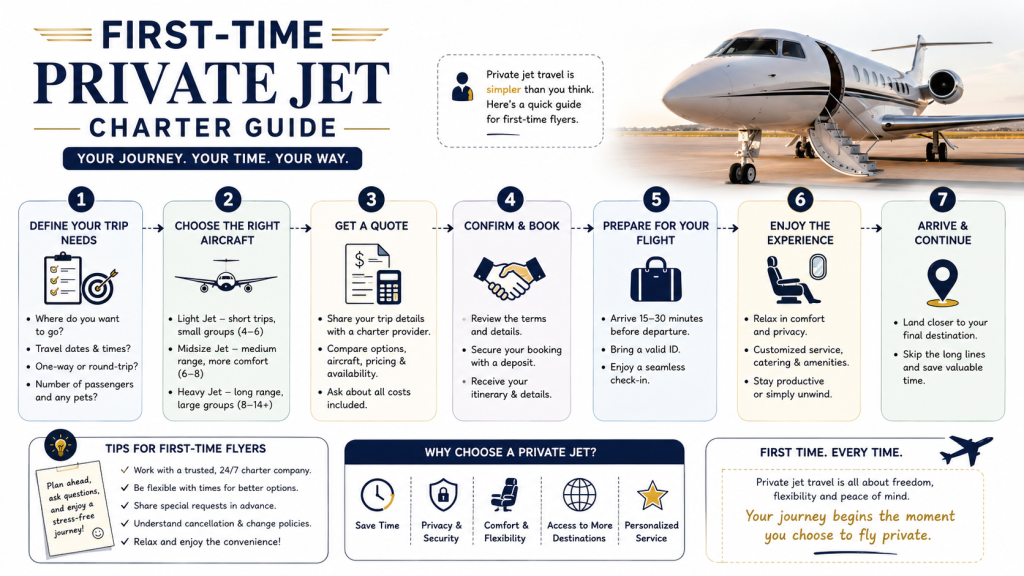
Private jet charter offers travelers a flexible alternative to scheduled commercial flights, but the booking process may feel unfamiliar to first-time passengers.
Understanding aircraft options, costs, travel requirements, and operational procedures can make the experience easier to plan.
Private aviation provides flexibility in many areas, but flights still operate under important safety, weather, and regulatory requirements.
This guide explains the key steps and considerations first-time travelers should understand before arranging a private jet charter.
What Is a Private Jet Charter?
A private jet charter involves arranging an aircraft for a specific journey rather than purchasing a seat on a scheduled commercial flight. The aircraft is selected based on the travel requirements of the passenger or group.
Unlike aircraft ownership, chartering does not require the traveler to purchase, maintain, insure, or manage the aircraft. Instead, the flight is arranged for a particular trip.
Private charter also differs from scheduled airline travel because passengers generally have greater flexibility regarding departure timing, aircraft selection, and airport options. However, the exact level of flexibility depends on aircraft availability, airport operating conditions, crew regulations, and other operational factors.
For first-time travelers, understanding these differences is an important starting point.
How Does Private Jet Charter Work?
The general private jet charter process begins with the traveler sharing their trip requirements.
Important details usually include:
- Departure location
- Destination
- Preferred travel date
- Preferred departure time
- Number of passengers
- Luggage requirements
- Special travel needs
- Return travel plans
Based on these requirements, suitable aircraft options can be identified.
After an aircraft is selected, the traveler receives details regarding the proposed flight arrangement. Once the booking is confirmed, final passenger information and travel requirements are completed.
Before departure, passengers receive instructions regarding the departure location, reporting time, and other necessary arrangements.
Although private aviation can simplify certain travel procedures, proper planning remains important.
Why First-Time Travelers Need Proper Planning
Planning helps ensure that the selected aircraft is suitable for the actual journey.
For example, a traveler should not select an aircraft based only on cabin appearance. Passenger capacity, travel distance, luggage space, airport suitability, and operational range are equally important.
Travelers should also consider whether the journey involves a single flight, multiple destinations, or an overnight stay.
Providing complete information early helps avoid last-minute changes.
Proper planning can also improve cost clarity because additional requirements may affect the overall flight arrangement.
Choosing the Right Type of Private Jet
Private aircraft are available in different categories, and each category is designed for different travel requirements.
Light Jets
Light jets are generally suitable for shorter trips and smaller passenger groups. They can be useful when travelers need efficient point-to-point transportation with moderate luggage requirements.
Midsize Jets
Midsize jets typically provide more cabin space and may offer greater range than light jets. They can be suitable for longer domestic or regional journeys.
Super-Midsize Jets
Super-midsize aircraft generally provide increased range, cabin comfort, and passenger capacity. They are often considered for longer journeys and groups requiring additional space.
Large-Cabin and Long-Range Jets
These aircraft are designed for longer-distance travel and can offer more spacious cabins and greater operational range.
The right aircraft should always be selected based on actual travel needs rather than simply choosing the largest or most luxurious option.
Major Private Jet Categories
| Aircraft Category | Typical Passenger Capacity | General Travel Range | Cabin Characteristics | Suitable Travel Situation |
|---|---|---|---|---|
| Light Jet | Small groups | Short to medium distance | Compact and efficient | Short business or personal trips |
| Midsize Jet | Medium-sized groups | Medium distance | More cabin and luggage space | Regional and longer domestic travel |
| Super-Midsize Jet | Larger groups | Long distance | Spacious and comfortable | Extended business or international travel |
| Large-Cabin Jet | Larger passenger groups | Long distance | High cabin comfort and facilities | Long-haul journeys |
| Long-Range Jet | Varies by aircraft | Very long distance | Designed for extended travel | International and intercontinental flights |
Actual passenger capacity and range depend on the specific aircraft model, weather conditions, payload, and operational planning.
Understanding Private Jet Charter Costs
Private jet charter costs can vary significantly depending on the journey and aircraft selected.
There is no single fixed price for every flight because each trip has different operational requirements.
Important factors that can influence the total cost include:
Aircraft Category
Larger aircraft generally involve different operating costs compared with smaller aircraft.
Flight Duration and Distance
Longer flights require more fuel, flight time, and operational resources.
Airport Charges
Different airports may have different landing, parking, handling, and facility charges.
Positioning Flights
In some situations, an aircraft may need to travel to the passenger’s departure location before beginning the charter journey.
Crew Requirements
Flight duration and operational schedules may require additional crew planning or overnight arrangements.
Ground Handling and Additional Services
Ground transportation, catering, special baggage handling, and other passenger requirements may affect the final arrangement.
First-time travelers should understand the complete cost structure and ask for clarity about what is included in the charter arrangement.
The Booking Process for First-Time Travelers
The booking process can generally be understood through a few practical steps.
Step 1: Share Travel Requirements
Provide accurate information about the route, date, passenger count, luggage, and special requirements.
Step 2: Review Suitable Aircraft Options
Consider aircraft suitability based on range, cabin capacity, luggage limitations, and airport accessibility.
Step 3: Understand the Proposed Arrangement
Review the itinerary and understand the operational details of the proposed flight.
Step 4: Confirm Passenger Information
Provide required passenger details and travel documentation accurately and within the required timeframe.
Step 5: Finalize Travel Arrangements
Confirm departure information, airport or terminal details, and any additional requirements.
Step 6: Prepare for Departure
Follow the reporting instructions provided for the flight and ensure all required identification and travel documents are available.
Clear communication throughout the process helps reduce avoidable complications.
Important Documents and Passenger Information
Passengers should provide accurate personal information when arranging a charter flight.
For domestic travel, identification requirements may vary according to local regulations and airport procedures.
International travel generally requires appropriate passports, visas where necessary, and other required documentation.
Travelers should not assume that private aviation removes immigration or customs requirements.
International private flights must still follow applicable border control, customs, and aviation procedures.
Providing passenger information early allows the necessary arrangements to be completed properly.
What to Expect at the Airport
Private jet passengers may depart from dedicated private aviation terminals or fixed-base operator facilities rather than the main commercial airline terminal.
The experience can be different from scheduled airline travel, particularly regarding terminal access and passenger processing.
However, private aviation does not eliminate operational or security requirements.
Passengers should follow instructions regarding arrival time, identification, baggage, and security procedures.
The departure process may be more direct, but travelers should still arrive according to the agreed schedule.
Airport access can also vary depending on the location, aircraft type, local regulations, and terminal facilities.
Luggage and Special Travel Requirements
Luggage capacity should be discussed before confirming the aircraft.
Private aircraft have different baggage compartments, cabin storage arrangements, and weight limitations.
Travelers carrying large equipment, sports items, musical instruments, or other unusual baggage should communicate this information in advance.
Special requirements may include:
- Traveling with pets
- Traveling with children
- Mobility assistance
- Medical equipment
- Special catering preferences
- Large or unusual luggage
Advance communication gives operators the opportunity to determine whether the selected aircraft can safely accommodate these requirements.
Safety and Operator Verification
Safety should be one of the most important considerations when arranging a private jet charter.
First-time travelers should understand the importance of using properly authorized and regulated flight operations.
Important areas to consider include:
- Applicable operating authorization
- Aircraft maintenance standards
- Crew qualifications
- Safety procedures
- Insurance arrangements
- Regulatory compliance
Travelers should not make decisions based only on aircraft appearance, luxury features, or price.
A professional operation should place safety and regulatory compliance at the center of its services.
Understanding Flight Flexibility
One of the commonly discussed benefits of private aviation is scheduling flexibility.
However, flexibility does not mean that a flight can operate without limitations.
Private jet operations can still be affected by:
- Weather conditions
- Airport operating hours
- Air traffic restrictions
- Crew duty limitations
- Aircraft availability
- Maintenance requirements
- Regulatory restrictions
First-time travelers should understand that safety-related decisions always take priority over schedule preferences.
Maintaining realistic expectations helps avoid confusion when operational changes become necessary.
Important Checks Before Confirming a Charter
| Factor to Check | Why It Is Important |
|---|---|
| Aircraft Suitability | Ensures the aircraft meets passenger, range, and luggage requirements |
| Total Cost Clarity | Helps travelers understand included and additional operational expenses |
| Operator Verification | Supports confidence in regulatory and safety standards |
| Luggage Capacity | Prevents last-minute baggage limitations |
| Passenger Documentation | Ensures travel requirements are completed correctly |
| Airport Arrangements | Confirms the correct departure and arrival facilities |
| Schedule Flexibility | Helps travelers prepare for possible operational changes |
| Weather Conditions | Supports realistic expectations about flight operations |
| Special Requirements | Ensures pets, children, mobility needs, or equipment are properly planned |
Common Mistakes First-Time Private Jet Charter Travelers Should Avoid
Choosing an Aircraft Based Only on Appearance
A visually impressive cabin does not automatically mean that an aircraft is suitable for the journey. Range, passenger capacity, baggage space, and airport requirements should also be considered.
Ignoring Luggage Limitations
Different aircraft have different baggage capacities. Travelers should provide accurate luggage details before confirming the flight.
Assuming Every Airport Can Accommodate Every Aircraft
Airport runway length, facilities, operating restrictions, and local conditions may affect which aircraft can use a particular airport.
Not Checking the Complete Cost Structure
Travelers should understand the full arrangement and clarify possible additional operational costs before confirming a charter.
Providing Passenger Information Late
Late information can create unnecessary complications, especially for international travel or journeys involving special requirements.
Assuming Private Flights Are Unaffected by Weather
Private aircraft must still operate safely within weather and operational limitations.
Ignoring Operator and Safety Verification
Safety standards, crew qualifications, and regulatory compliance should always be important considerations.
Making Last-Minute Changes Without Understanding Limitations
Changes to passenger numbers, destinations, schedules, or luggage requirements can affect aircraft suitability and operational planning.
Important Considerations Before Booking
Before confirming a private jet charter, travelers should consider more than convenience.
Safety
Ensure that the flight arrangement follows appropriate aviation safety and regulatory requirements.
Aircraft Suitability
The aircraft should match the route, passenger count, baggage requirements, and travel conditions.
Cost Transparency
Understanding the complete cost structure helps avoid misunderstandings.
Weather
Weather can affect both private and commercial aviation operations.
Airport Access
Confirm that the selected departure and arrival airports are suitable for the planned aircraft.
Passenger Requirements
Communicate special needs early so that appropriate arrangements can be considered.
Travel Documentation
Ensure that identification, passports, visas, and other required documents are ready before travel.
Practical Tips for a Smooth First Private Jet Charter Experience
Provide complete travel information from the beginning.
Be realistic about passenger numbers and luggage requirements because these factors can affect aircraft selection.
Ask questions if any part of the itinerary or flight arrangement is unclear.
Keep important travel documents ready before departure.
Communicate special requirements early rather than waiting until the day of travel.
Follow the recommended arrival time provided for the departure facility.
Remain flexible when weather or safety considerations require changes.
Most importantly, prioritize proper planning and safety over unnecessary last-minute decisions.
FAQs
1. How does private jet charter work?
Private jet charter involves arranging an aircraft for a specific journey based on the passenger’s route, schedule, group size, and travel requirements.
2. How early should I arrange a private jet charter?
Advance planning can provide more aircraft options and allow sufficient time to complete passenger and operational arrangements. The required timeframe depends on the trip.
3. How is the right aircraft selected?
Aircraft selection depends on factors such as passenger count, travel distance, luggage, airport accessibility, and desired cabin requirements.
4. Are private jet flights affected by weather?
Yes. Private jet operations are affected by weather conditions, visibility, wind, storms, and other factors that may influence flight safety.
5. How much luggage can passengers carry?
Luggage capacity varies depending on the aircraft type, passenger count, and weight limitations. Travelers should discuss baggage requirements before booking.
6. What documents are required for private jet travel?
Required documents depend on the route and regulations. International travel may require passports, visas, customs documentation, and other applicable travel documents.
7. Can pets travel on private jets?
Pets may be accommodated on some private flights, subject to applicable regulations, aircraft suitability, and advance arrangements.
8. Are private aviation terminals different from commercial terminals?
Private flights may use dedicated terminals or private aviation facilities, but procedures and available services vary by airport.
9. How flexible are private jet schedules?
Private aviation can offer greater scheduling flexibility than many scheduled flights, but weather, airport restrictions, crew regulations, and aircraft availability can still affect operations.
10. What should first-time travelers check before booking?
First-time travelers should check aircraft suitability, cost clarity, operator credentials, passenger documentation, luggage capacity, airport arrangements, and possible operational limitations.
Conclusion
A first private jet charter experience can be easier to manage when travelers understand the basic booking process and plan their requirements carefully. Choosing a suitable aircraft, providing accurate passenger and luggage information, understanding the cost structure, and considering airport and operational limitations are all important steps. While private aviation can offer greater flexibility, safety, weather conditions, regulations, and operational requirements remain essential factors. Proper preparation helps first-time travelers approach private jet charter with realistic expectations and greater confidence.
