
Introduction
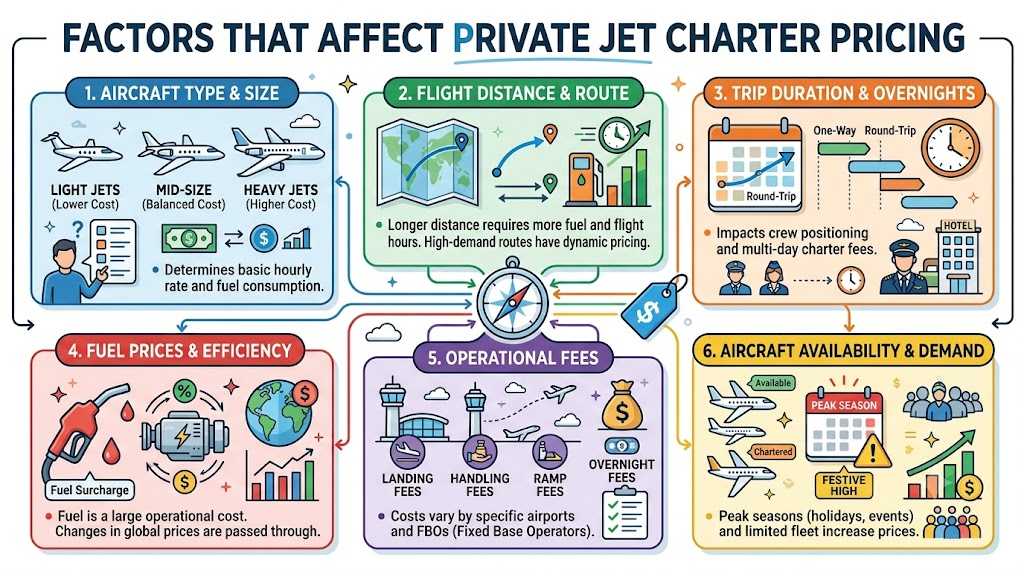
Private jet charter pricing can vary widely from one journey to another, even when two flights cover a similar distance. The aircraft selected, route, travel date, airport charges, fuel requirements, crew expenses, and several operational details can all influence the final quotation.
Understanding these factors helps travelers evaluate charter quotes more realistically and avoid focusing only on the advertised hourly rate. This guide explains the main elements that determine private jet charter pricing and what travelers should consider before comparing different options.
What Determines Private Jet Charter Pricing?
Private jet charter pricing is not usually based on a single fixed amount. Instead, operators consider the complete cost of arranging and operating a particular flight.
A charter quotation may include the aircraft’s operating cost, flight time, crew expenses, fuel, airport charges, positioning costs, taxes, and additional services. The combination of these factors makes every charter request somewhat different.
For this reason, two passengers traveling between the same cities may receive different quotations depending on the aircraft, schedule, availability, and other requirements.
1. Aircraft Type and Size
One of the most important factors affecting private jet charter pricing is the type of aircraft selected.
Private aircraft are available in several categories, including light jets, midsize jets, super-midsize jets, heavy jets, and long-range aircraft. Larger aircraft generally have more cabin space, greater passenger capacity, longer range, and additional onboard facilities.
However, larger aircraft also tend to have higher operating costs. They may consume more fuel, require different airport services, and involve higher crew or maintenance expenses.
A traveler flying with a small group on a relatively short route may not need a large long-range aircraft. Choosing an aircraft appropriate for the number of passengers and distance can therefore have a major effect on the overall charter cost.
Aircraft Categories and Their Typical Uses
| Aircraft Category | Typical Passenger Capacity | Typical Use | Relative Cost Level | Main Pricing Factors |
|---|---|---|---|---|
| Light Jet | Small group | Short regional trips | Lower | Flight time, fuel, airport fees |
| Midsize Jet | Medium group | Regional and longer domestic trips | Moderate | Range, cabin size, operating hours |
| Super-Midsize Jet | Larger group | Longer domestic and international trips | Higher | Range, fuel, crew, airport charges |
| Heavy Jet | Larger group | Long-distance travel | High | Aircraft size, fuel, crew, flight duration |
| Long-Range Jet | Larger group | Extended international routes | High to very high | Range, fuel, crew, international operations |
These categories are general and aircraft specifications vary by model and configuration.
2. Flight Distance and Route
The distance between the departure and destination airports directly affects operating costs.
A longer flight normally requires more fuel and more flight time. The aircraft may also need additional crew planning depending on the length and operational requirements of the journey.
The route itself can matter as well. A direct route may not always be operationally possible. Air traffic restrictions, weather, airport limitations, airspace requirements, or other factors can affect the planned flight path.
International routes can introduce additional operational requirements, making the overall quotation different from a comparable domestic flight.
3. Flight Duration and Hourly Charter Rates
Private jet operators commonly use aircraft hourly rates as one component of charter pricing. The hourly rate reflects many underlying costs associated with operating the aircraft.
These can include fuel, maintenance, crew expenses, insurance, aircraft ownership or leasing costs, and other operational overheads.
However, travelers should not assume that multiplying an advertised hourly rate by the estimated flight time will always produce the final price.
Some charter arrangements involve minimum billable hours. There can also be repositioning time or other operational expenses that need to be considered.
This is why the total charter quotation is generally more useful for comparison than looking at an hourly rate alone.
4. Aircraft Availability and Positioning
The aircraft does not necessarily start its journey from the same airport as the passenger.
For example, a traveler may request a flight from City A to City B while the selected aircraft is currently located in City C. The aircraft may need to fly to City A before picking up the passengers.
This is known as repositioning.
Repositioning can add flight time and operating expenses to the charter. Depending on the aircraft’s schedule and the operator’s planning, these costs may influence the final quotation.
Aircraft availability is therefore an important part of private jet pricing. A suitable aircraft already positioned near the departure airport may produce a different cost from one that needs to be brought in from another location.
5. Airport Selection
The airports used for a private charter can also affect the overall price.
Airports may charge different amounts for landing, parking, handling, passenger services, and other facilities. Some airports also have restrictions involving operating hours, aircraft size, runway characteristics, or available slots.
Private aircraft sometimes use smaller airports that are more convenient for passengers. However, the fees and services at these airports can vary considerably.
For international travel, additional customs, immigration, and handling arrangements may also be necessary.
Consequently, choosing the departure and arrival airports should be considered as part of the total pricing calculation.
6. Fuel Costs
Fuel is a significant operating expense for private aircraft.
Different aircraft consume different amounts of fuel depending on their size, engines, weight, flight distance, altitude, and operating conditions. A larger aircraft traveling a long distance will generally require considerably more fuel than a smaller aircraft on a short journey.
Fuel prices can also change over time and vary by location.
The amount of fuel required for a particular flight is therefore one of the factors that can influence the charter quotation.
Travelers should remember that fuel is only one part of the total cost. A lower-fuel-consumption aircraft may still have different pricing because of its aircraft category, availability, crew requirements, or other operating expenses.
7. Crew Costs
Private jet flights require qualified flight crew, and longer or more complex journeys may have additional crew requirements.
Crew costs can include pilot compensation, accommodation, meals, transportation, and other expenses associated with positioning and scheduling the crew.
Duty-time regulations also influence flight planning. If a journey requires the crew to stay overnight at the destination or another location, accommodation and related expenses may become part of the overall cost.
Therefore, a flight with the same aircraft and route can sometimes have different pricing depending on the schedule and crew requirements.
8. Taxes, Fees, and Airport Charges
The final charter price can include several charges beyond the aircraft’s basic flying cost.
Depending on the journey, these may include:
- Landing fees
- Airport handling charges
- Parking fees
- Navigation-related charges
- Passenger facility charges
- Applicable taxes
- International processing charges
- Customs or immigration-related expenses
The exact charges depend on the airports, countries, route, aircraft, and applicable regulations.
This is one reason travelers should ask whether a quotation is an all-inclusive price or an estimate that excludes certain expenses.
9. Travel Date and Season
The date of travel can influence aircraft availability and charter pricing.
Demand may increase during holidays, major sporting events, business events, festivals, or other periods when many travelers are looking for private aviation services.
When demand is high and aircraft availability is limited, prices may differ from those available during less busy periods.
Flexible travelers may have more options if they can adjust their departure time or travel date. Even changing the schedule by several hours can sometimes affect which aircraft are available.
10. Onboard Services and Special Requests
Private jet charter allows travelers to request services according to their needs, but additional services can influence the final cost.
Examples include specialized catering, particular meal requirements, ground transportation, special passenger arrangements, or other customized services.
The cost depends on what is requested and whether the service is already included in the charter package.
Travelers should therefore ask exactly what services are included in the quotation before comparing one operator’s price with another.
11. International Travel Requirements
International private jet flights can involve more operational planning than domestic flights.
The aircraft may require permits to overfly or land in particular countries. Customs and immigration procedures may also need to be arranged.
International handling services, parking, local airport charges, and regulatory requirements can all contribute to the total cost.
The complexity of these arrangements varies according to the countries involved, the route, the airports, and the aircraft.
12. Round-Trip Travel and Waiting Time
A round-trip charter is not automatically priced as simply twice the cost of a one-way flight.
The operator needs to consider what the aircraft and crew will do between the outbound and return journeys.
If the aircraft waits at the destination for an extended period, parking, crew accommodation, and other expenses may apply. In some situations, it may be more operationally efficient for the aircraft to return elsewhere and come back later.
The travel schedule therefore plays an important role in determining the economics of a round trip.
13. Aircraft Model and Operating Efficiency
Aircraft within the same general category can have different operating characteristics.
Two midsize jets, for example, may differ in fuel consumption, range, cabin configuration, passenger capacity, and operating expenses.
Newer aircraft may also offer different efficiency characteristics compared with older models, although aircraft age alone does not determine charter pricing.
The specific aircraft model, its availability, configuration, and operating economics can all contribute to differences between charter quotations.
14. Empty-Leg Flights
An empty-leg flight occurs when an aircraft needs to fly without passengers because it is repositioning for another scheduled journey.
Operators may sometimes offer these flights at attractive rates because the aircraft is already scheduled to make the flight.
However, empty-leg opportunities are less flexible than conventional charter bookings. The route, departure time, and aircraft are generally determined by the aircraft’s existing schedule.
An empty leg can therefore provide a potential cost-saving opportunity, but it may not suit travelers who require a specific departure time or destination.
A Practical Example of How Pricing Can Change
Consider two groups planning to travel the same distance.
The first group consists of three passengers traveling on a flexible weekday. A suitable light jet is already positioned close to their departure airport, and the airport charges are relatively straightforward.
The second group has eight passengers traveling during a major holiday period. They require a larger aircraft, have a fixed departure time, and the selected aircraft must first be repositioned from another city.
Although both groups are traveling a similar distance, their charter prices could be very different.
The difference is not necessarily because one operator is charging more. The aircraft category, availability, positioning, schedule, demand, and operational requirements are different.
This example demonstrates why private jet charter pricing should be evaluated based on the complete trip rather than distance alone.
Common Mistakes Travelers Should Avoid
Comparing Only the Hourly Rate
An attractive hourly rate does not necessarily mean a lower total charter price. Minimum flight hours, repositioning, airport charges, and other expenses can change the final amount.
Choosing an Aircraft That Is Too Large
A larger aircraft may provide more space and range, but those advantages may not be necessary for every journey. Travelers should select an aircraft according to their actual passenger and route requirements.
Ignoring Positioning Costs
If the aircraft is based far from the departure airport, repositioning may increase the total cost.
Forgetting Additional Airport Charges
Landing, handling, parking, and other airport-related expenses can contribute to the final bill.
Not Checking What the Quote Includes
Different quotations may include different services. Travelers should understand whether taxes, catering, ground transportation, crew expenses, and other charges are included.
Assuming Round Trips Are Always Cheaper
A round trip can be economical in some circumstances, but aircraft positioning and waiting requirements can make the calculation more complicated.
Booking Without Considering Flexibility
A fixed travel date and departure time may limit aircraft choices. Flexible scheduling can sometimes provide access to more suitable aircraft or empty-leg opportunities.
Major Factors and Their Effect on Pricing
| Pricing Factor | Why It Matters | Possible Effect on Charter Cost |
|---|---|---|
| Aircraft type | Determines capacity, range, and operating requirements | Lower to significantly higher |
| Flight distance | Influences fuel and flight time | Usually increases with distance |
| Aircraft positioning | Aircraft may need to travel to the pickup airport | Can increase total cost |
| Airport charges | Airports have different fees and services | Varies by airport |
| Fuel | Aircraft consume different amounts of fuel | Can materially affect cost |
| Crew requirements | Longer trips may require additional crew planning | Can increase cost |
| Travel date | Demand and availability change over time | Higher during busy periods |
| International requirements | Permits and border procedures may be needed | Can add operational expenses |
| Special services | Customized services may have additional costs | Depends on request |
| Waiting time | Aircraft and crew may need to remain at destination | Can increase trip cost |
| Empty-leg availability | Existing repositioning flights may reduce certain costs | May provide lower-cost options |
Important Considerations Before Accepting a Charter Quote
A private jet charter quotation should be reviewed as a complete package rather than judged by one number.
First, check the aircraft type and confirm that it meets the passenger, baggage, and range requirements of the journey. An aircraft that looks inexpensive may not be the most practical choice if it requires additional stops or positioning.
Next, understand the flight schedule. The departure and arrival airports, expected flight time, and aircraft positioning can all affect the price.
It is also important to ask about additional charges. Find out whether airport fees, taxes, catering, crew expenses, parking, and other services are included or billed separately.
Travelers should also pay attention to cancellation, rescheduling, and schedule-change conditions. Private charter arrangements can involve specific terms, and understanding them before booking can prevent unexpected costs.
Finally, price should not be considered separately from operational standards and regulatory compliance. A suitable charter arrangement should meet the traveler’s requirements while being operated according to applicable aviation regulations and safety standards.
Frequently Asked Questions
1. What determines the price of a private jet charter?
Private jet charter pricing depends on aircraft type, flight distance, flight duration, aircraft availability, positioning, airport charges, fuel, crew expenses, travel date, taxes, and additional services.
2. Does aircraft size affect private jet charter pricing?
Yes. Larger aircraft generally have greater capacity and range but can also have higher fuel consumption and operating costs. Selecting an aircraft appropriate for the trip can help avoid unnecessary expense.
3. Is private jet charter pricing based only on flying hours?
No. Flight hours are an important component, but the total quotation may also include positioning, airport charges, crew costs, taxes, fuel-related expenses, and other operational requirements.
4. Does the departure airport affect the charter price?
Yes. Airports have different landing, handling, parking, and other service charges. Airport operating restrictions can also affect aircraft selection and scheduling.
5. Are fuel costs included in a private jet charter quote?
Fuel costs are normally part of the operator’s overall pricing calculation, but the way they are presented can vary between quotations. Travelers should confirm exactly what is included in the quoted amount.
6. Can an empty-leg flight reduce charter costs?
An empty-leg flight can sometimes be available at a lower cost because the aircraft is already scheduled to reposition. However, its route and timing are usually less flexible than a dedicated charter.
7. Does a round trip always cost less than two one-way flights?
Not necessarily. The cost depends on aircraft positioning, waiting time, crew requirements, and the schedule between the outbound and return flights.
8. Do international private jet flights have additional charges?
They can. International flights may require permits, customs and immigration arrangements, international handling, navigation-related expenses, and other country-specific requirements.
9. Can travel dates affect private jet charter prices?
Yes. Aircraft availability and demand can change depending on the date. Peak holidays and major events may create higher demand and fewer available aircraft.
10. What should travelers check before accepting a charter quotation?
Travelers should check the aircraft type, total price, included services, airport charges, positioning costs, taxes, cancellation terms, schedule, and any additional expenses that could be charged separately.
Conclusion
Private jet charter pricing is influenced by much more than the distance between two airports. Aircraft type, flight duration, positioning, airport charges, fuel, crew requirements, travel dates, international procedures, and additional services can all contribute to the final quotation.
Understanding these factors makes it easier to compare charter options and identify what is actually included in a price. Instead of focusing only on an hourly rate, travelers should evaluate the complete cost of the journey and consider how the aircraft and schedule match their requirements.
A well-understood charter quotation allows travelers to make a more informed decision and reduces the possibility of unexpected costs during the booking process.
