
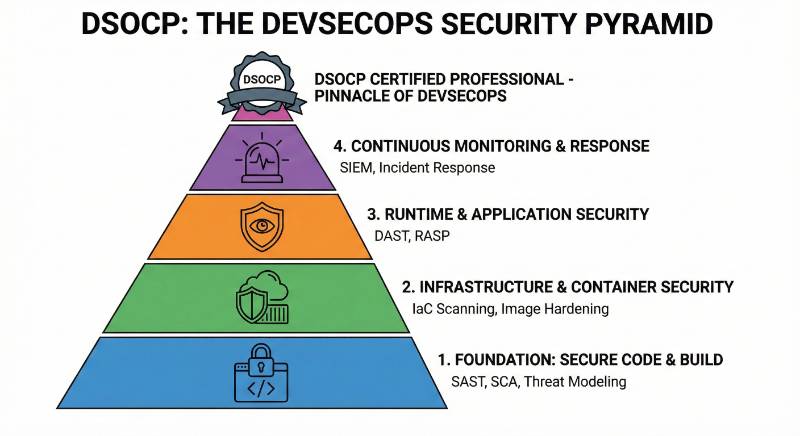
Introduction
The modern software development lifecycle (SDLC) places a strong emphasis on speed and efficiency. However, with increasing cyber threats and stricter regulatory requirements, security cannot be an afterthought. DevSecOps, which integrates security into every part of the DevOps pipeline, addresses this gap. The DevSecOps Certified Professional (DSOCP) certification, offered by DevOpsSchool, is designed to equip professionals with the skills to incorporate security at every stage of development—from planning to deployment.
I can tell you that the DSOCP certification is essential for anyone looking to advance in the field of DevSecOps. In this guide, we’ll explore the details of the DSOCP certification, the skills you’ll gain, the preparation plan, and the real-world impact it can have on your career.
What is the DevSecOps Certified Professional (DSOCP)?
The DevSecOps Certified Professional (DSOCP) certification is an advanced-level qualification designed for professionals who want to integrate security practices into the DevOps pipeline. Unlike traditional DevOps, which often focuses on automation and development, DevSecOps ensures security is built into every stage of the SDLC—ensuring vulnerabilities are detected early and security remains a priority throughout the lifecycle. The DSOCP certification teaches professionals how to use tools like Jenkins, GitLab CI, Snyk, Terraform, and Kubernetes, focusing on secure software development, automated security testing, vulnerability management, and securing cloud infrastructure.
Who Should Take the DSOCP Certification?
The DSOCP certification is ideal for the following professionals:
1. DevOps Engineers
Professionals working in DevOps who want to specialize in integrating security into their pipelines, ensuring that security is not a bottleneck but an integral part of the process.
2. Security Engineers
Security specialists who wish to focus on automating security practices within DevOps, ensuring continuous security across all stages of the SDLC.
3. Software Engineers
Developers looking to adopt secure coding practices and integrate security into their CI/CD pipelines, ensuring that vulnerabilities are caught early in the development process.
4. Cloud Engineers
Professionals working with cloud platforms (AWS, Azure, GCP) who want to secure cloud infrastructure and applications while automating security practices.
5. Engineering Managers
Managers overseeing DevOps or security teams who want to implement DevSecOps practices across their organization and lead secure development initiatives.
6. Aspiring DevSecOps Practitioners
Individuals looking to transition into DevSecOps roles and enhance their skills in securing modern software development workflows.
Skills You’ll Gain from the DSOCP Certification
Upon completing the DSOCP certification, you will gain hands-on expertise in the following areas:
- CI/CD Security: Automating security within continuous integration and continuous delivery pipelines.
- Cloud Security: Securing cloud platforms and automating security in cloud environments like AWS, Azure, and GCP.
- Container Security: Learning how to secure containerized applications with Docker and Kubernetes.
- Security Automation: Using tools like Snyk, OWASP ZAP, and Burp Suite to automate security checks and vulnerability scanning.
- Vulnerability Management: Identifying, assessing, and remediating security vulnerabilities in the development pipeline.
- Compliance Automation: Implementing security controls to ensure regulatory compliance (e.g., HIPAA, GDPR).
- Incident Response: Setting up automated responses to security incidents and breaches within the pipeline.
Real-World Projects You Should Be Able to Do After It
After completing the DSOCP certification, you should be able to handle the following real-world projects:
- Secure CI/CD Pipelines: Automating security testing, vulnerability scanning, and compliance checks within the CI/CD pipeline using tools like Jenkins and GitLab.
- Cloud Security Implementations: Securing cloud infrastructure, implementing identity and access management (IAM), encryption, and automated security testing in cloud platforms.
- Container Security: Secure Docker containers and Kubernetes clusters, ensuring that security practices are embedded in the container lifecycle.
- Automated Vulnerability Management: Integrating vulnerability scanning tools like OWASP ZAP and Snyk into the DevOps pipeline to ensure continuous security.
- Compliance Enforcement: Automating compliance checks to meet industry regulations (e.g., SOC 2, PCI-DSS, HIPAA) throughout the SDLC.
Preparation Plan for DSOCP Certification
The preparation for DSOCP can vary based on your prior knowledge and experience. Below are three suggested study plans based on your available study time: 7–14 days, 30 days, and 60 days.
7–14 Days Preparation Plan
Ideal for: Professionals with a basic understanding of DevOps and security practices.
Week 1: DevSecOps Basics & CI/CD Security
- Day 1–3: Understand the fundamentals of DevSecOps and the importance of security in DevOps. Learn the basic concepts of securing CI/CD pipelines.
- Day 4–7: Focus on security practices in version control and CI/CD tools like Jenkins and GitLab CI.
Week 2: Cloud & Container Security
- Day 8–10: Study cloud security best practices, including IAM policies, encryption, and securing cloud infrastructure (AWS, Azure, GCP).
- Day 11–14: Dive into container security, focusing on securing Docker and Kubernetes environments.
30-Day Preparation Plan
Ideal for: Professionals with some experience in DevOps and security who want to enhance their expertise.
Week 1–2: CI/CD Security & Vulnerability Scanning
- Day 1–7: Master the integration of security within CI/CD pipelines. Set up automated vulnerability scanning using tools like Snyk and Burp Suite.
- Day 8–14: Learn advanced security testing practices in DevOps environments, using OWASP ZAP and static code analysis.
Week 3–4: Cloud & Container Security
- Day 15–21: Focus on securing cloud infrastructure and applications. Learn automated security for cloud environments.
- Day 22–30: Deep dive into container security, container orchestration with Kubernetes, and security in multi-cloud environments.
60-Day Preparation Plan
Ideal for: Professionals aiming for in-depth mastery and hands-on practice in all areas of DevSecOps.
Week 1–2: DevSecOps Fundamentals & CI/CD Security
- Day 1–7: Understand DevSecOps principles and CI/CD pipeline security. Implement security controls from development to deployment.
- Day 8–14: Learn about security automation tools, including vulnerability scanners, static code analysis, and container security tools.
Week 3–4: Cloud Security & Compliance
- Day 15–21: Study cloud security best practices for securing AWS, Azure, or GCP environments. Implement automated compliance tools.
- Day 22–28: Set up cloud resource security, including IAM, encryption, and secure API management.
Week 5–6: Advanced Container Security & Real-World Projects
- Day 29–35: Master container security using Docker and Kubernetes. Automate security checks and integrate them into the pipeline.
- Day 36–42: Implement advanced compliance and security monitoring tools for real-time incident response.
- Day 43–60: Complete real-world projects integrating security in CI/CD, cloud, and containerized environments.
Common Mistakes to Avoid
- Skipping Security Automation: Ensure security practices are automated at every stage of the DevOps pipeline to catch vulnerabilities early.
- Neglecting Cloud Security: Cloud environments need comprehensive security. Don’t overlook access control, data encryption, or securing cloud resources.
- Overlooking Container Security: Containers must be secured throughout the lifecycle, including during development, testing, and production.
- Not Ensuring Continuous Compliance: Compliance checks should be part of the DevOps pipeline. Always automate compliance to meet regulatory standards.
Best Next Certification After DSOCP
- Same Track: Certified DevSecOps Professional (CDP)
- Cross-Track: Certified Kubernetes Administrator (CKA)
- Leadership Track: Certified DevOps Leader (CDL)
Choose Your Path: DevOps Learning Paths
After completing the DevSecOps Certified Professional (DSOCP) certification, you can choose to specialize further by exploring one of the following DevOps learning paths. Each path focuses on different aspects of DevOps and provides you with deeper expertise in specific areas.
1. DevOps
Focus on mastering the core DevOps tools and techniques that optimize the software delivery pipeline, improve collaboration, and automate workflows across development, testing, and operations.
2. DevSecOps
Dive deeper into the intersection of security and DevOps. Specialize in integrating security practices into every phase of the DevOps lifecycle to ensure continuous, automated security at every stage of software delivery.
3. Site Reliability Engineering (SRE)
Learn how to enhance the reliability, availability, and scalability of services. Site Reliability Engineers focus on building scalable, resilient systems while ensuring minimal downtime and efficient incident management.
4. AIOps/MLOps
Implement Artificial Intelligence (AI) and Machine Learning (ML) into the DevOps pipeline. Learn how to leverage AI/ML for smarter automation, anomaly detection, and predictive analytics to improve operations and reduce incidents.
5. DataOps
Focus on automating and managing data pipelines. With DataOps, you ensure efficient and secure data processing, enabling faster data analysis and supporting data-driven decision-making across the organization.
6. FinOps
Specialize in managing cloud financial operations and optimizing cloud costs within DevOps workflows. Learn how to align engineering teams with financial goals, monitor cloud spend, and improve cost efficiency while maintaining high performance and scalability.
These learning paths will guide you in advancing your career by deepening your knowledge in a specific domain of DevOps. Whether you want to focus on security, automation, or cloud cost management, these paths offer specialized training to help you become an expert in your field.
Role → Recommended Certifications
| Role | Recommended Certifications |
|---|---|
| DevOps Engineer | DSOCP, CDP, CKA |
| SRE | DSOCP, SRE, CKA |
| Platform Engineer | DSOCP, CKA, CKAD |
| Cloud Engineer | DSOCP, AWS Certified Solutions Architect |
| Security Engineer | DSOCP, DevSecOps, CISM |
| Data Engineer | DSOCP, DataOps, Google Data Engineer |
| FinOps Practitioner | DSOCP, FinOps, Certified Cloud Financial Professional |
| Engineering Manager | DSOCP, CDL, DevOps Leader |
Certifications Table
| Track | Level | Who it’s for | Prerequisites | Skills Covered | Recommended Order | Link |
|---|---|---|---|---|---|---|
| DSOCP | Advanced | Security Engineers, DevOps Professionals | Experience in DevOps, Security Basics | CI/CD Security, Cloud Security, Automation | DSOCP → CDP → CKA | DSOCP Certification |
FAQs on DevSecOps Certified Professional (DSOCP)
- What are the prerequisites for the DSOCP certification?
Basic knowledge of DevOps principles, security practices, cloud platforms (AWS, Azure, GCP), and CI/CD pipelines is recommended. Prior experience with tools like Jenkins, Docker, and Kubernetes is beneficial but not mandatory. - How long does it take to complete the DSOCP certification?
The DSOCP certification typically takes 1-2 months to complete, depending on your prior knowledge and the amount of time you can dedicate to studying. - Can I take the DSOCP certification exam online?
Yes, the DSOCP certification exam is available online, which allows candidates from around the world to take the exam remotely. - What skills will I gain from the DSOCP certification?
You will learn to automate security within CI/CD pipelines, secure cloud infrastructure, integrate container security, manage vulnerabilities, and automate security and compliance checks. - What are the career benefits after completing DSOCP?
Completing the DSOCP certification will open up roles such as DevSecOps Engineer, Security Engineer, Cloud Security Architect, and CI/CD Security Specialist. It will also increase your earning potential and career growth opportunities in security and DevOps. - What tools are covered in the DSOCP certification?
The certification covers tools like Snyk, OWASP ZAP, Burp Suite, Jenkins, Terraform, Docker, Kubernetes, and Prometheus, among others, for automating security testing, vulnerability scanning, and cloud security. - Is DSOCP certification globally recognized?
Yes, the DSOCP certification is widely recognized in the cybersecurity and DevOps fields and is highly valued by organizations looking for professionals who can secure their development pipelines and cloud infrastructures. - How can I prepare for the DSOCP certification exam?
Prepare by following a structured study plan that covers DevSecOps principles, CI/CD security, cloud security, container security, and hands-on practice with security tools. Real-world projects and practical experience will be key to success. - How is the DSOCP certification exam conducted?
The exam is an online, proctored exam consisting of multiple-choice questions, practical case studies, and scenario-based questions to test your understanding of DevSecOps concepts and tools. - What is the difference between DevSecOps and traditional DevOps?
DevSecOps integrates security into the DevOps pipeline from the beginning, ensuring that security is a continuous process rather than an afterthought. Traditional DevOps may only address security at the end of the development cycle. - What are the next certifications to pursue after DSOCP?
After DSOCP, you can pursue certifications such as Certified DevSecOps Professional (CDP) to specialize further in DevSecOps or Certified Kubernetes Administrator (CKA) for deeper container security knowledge. Leadership roles can also lead you to certifications like Certified DevOps Leader (CDL).
General FAQs
- What is the purpose of DevSecOps?
DevSecOps integrates security directly into the DevOps pipeline, making security an ongoing process from the beginning of the software development lifecycle (SDLC). It aims to build secure applications by identifying and addressing security issues early and continuously. - How does DevSecOps enhance software development?
By embedding security into the DevOps process, DevSecOps helps organizations build faster, more secure applications. It reduces security risks and vulnerabilities by automating security measures and increasing collaboration between development, security, and operations teams. - What is the difference between DevSecOps and traditional security practices?
Traditional security practices often occur after the development process, while DevSecOps integrates security throughout the SDLC. This proactive approach allows for faster identification of vulnerabilities and faster remediation, preventing costly fixes later in the cycle. - How does DevSecOps support faster time-to-market?
By integrating security into the development pipeline, DevSecOps automates security testing and compliance checks, reducing delays in software delivery. Developers and operations teams can continue to work efficiently without waiting for manual security audits or late-stage security reviews. - What are the key security challenges DevSecOps addresses?
DevSecOps tackles challenges such as vulnerabilities in code, misconfigured cloud resources, insecure APIs, and lack of collaboration between security, development, and operations teams. It ensures that security is not a bottleneck but an integrated part of the development process. - What types of companies benefit most from DevSecOps?
Organizations in industries with high security and compliance requirements, such as finance, healthcare, e-commerce, and government, benefit the most from DevSecOps. However, any company aiming to streamline its software development and enhance security can leverage DevSecOps practices. - What is the role of automation in DevSecOps?
Automation in DevSecOps helps ensure continuous security by automating vulnerability scanning, testing, and compliance checks within the CI/CD pipeline. It reduces manual errors and speeds up the security process without compromising quality. - How does DevSecOps improve incident response times?
DevSecOps enhances incident response by integrating automated monitoring and alerting systems. Security events are detected and addressed in real-time, reducing response times and minimizing the impact of security breaches. - Is DevSecOps applicable only for large organizations?
No, DevSecOps can be implemented in organizations of any size. In fact, smaller organizations can benefit greatly from its ability to quickly scale security practices and automate security measures, which helps mitigate risks without adding significant overhead. - What tools are commonly used in DevSecOps?
Common DevSecOps tools include Jenkins (CI/CD), Terraform (Infrastructure as Code), Docker (containers), Kubernetes (orchestration), Snyk (vulnerability scanning), OWASP ZAP (security testing), Burp Suite (penetration testing), and Prometheus (monitoring).
Top Institutions Offering DSOCP Certification
- DevOpsSchool: The official provider of the DSOCP certification, offering hands-on training with expert-led sessions and live projects.
- Cotocus: Provides DevSecOps and security training with a focus on real-world application and project-based learning.
- ScmGalaxy: Known for in-depth training on DevOps and security practices, covering essential tools and methodologies.
- BestDevOps: Offers practical training and certifications with an emphasis on integrating security within DevOps workflows.
- DevSecOpsSchool: Specializes in DevSecOps training, focusing on securing DevOps pipelines and practices.
- SRESchool: Focuses on Site Reliability Engineering with a security angle, complementing DevSecOps knowledge.
- AIOpsSchool: Offers training on integrating AI and machine learning into DevOps workflows for smarter automation.
- DataOpsSchool: Provides training on automating and managing data pipelines within a DevOps environment.
- FinOpsSchool: Specializes in optimizing cloud costs and financial operations within the context of DevOps.
Conclusion
The DevSecOps Certified Professional (DSOCP) certification is a vital qualification for anyone looking to secure modern software delivery processes. By mastering the integration of security throughout the DevOps lifecycle, you’ll be ready to ensure that security is a continuous, proactive part of every development project. This certification will open up new career opportunities, advance your expertise in security practices, and equip you to meet the growing demand for professionals skilled in DevSecOps.