
Introduction
Kubernetes is powerful, but without strong security it can expose your business to serious risks like data leaks, container escapes, or cluster takeovers. As more critical applications move to Kubernetes, organisations need specialists who understand how to secure clusters, workloads, and the full container supply chain—not just keep them running. The Certified Kubernetes Security Specialist (CKS) certification is built for this need and proves you can apply real, end‑to‑end security best practices in live Kubernetes environments.
This master guide is for working engineers, software developers, SREs, platform and cloud engineers, and managers in India and worldwide. It explains the CKS certification in simple language: what it is, who should take it, what skills you gain, how to prepare in 7–14, 30, or 60 days, and how to connect it with DevOps, DevSecOps, SRE, AIOps/MLOps, DataOps, and FinOps career paths.
What Is the Certified Kubernetes Security Specialist (CKS)?
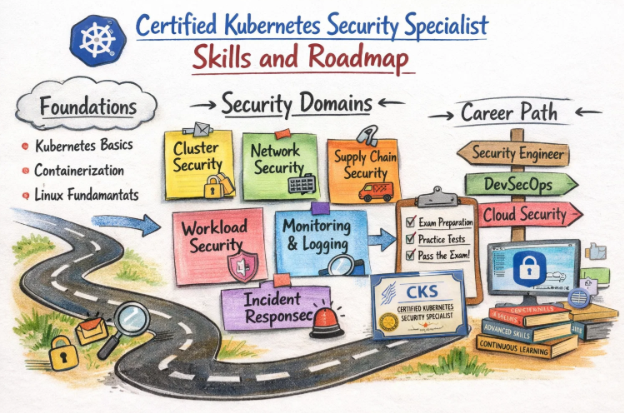
The Certified Kubernetes Security Specialist (CKS) is an advanced, hands‑on certification from the Cloud Native Computing Foundation (CNCF) and The Linux Foundation. It proves that you can secure container‑based applications and Kubernetes platforms across build, deploy, and runtime stages, using real tools on a live cluster.
Key exam details:
- Online, remote‑proctored, performance‑based exam.
- About 2 hours long with multiple practical tasks.
- You work from the command line in Kubernetes, not in multiple‑choice questions.
- You must have an active Certified Kubernetes Administrator (CKA) before attempting CKS.
CNCF defines the main domains and weights as:
- Cluster Setup – 10%
- Cluster Hardening – 15%
- System Hardening – 15%
- Minimize Microservice Vulnerabilities – 20%
- Supply Chain Security – 20%
- Monitoring, Logging, and Runtime Security – 20%
Who Should Take the CKS Certification Training?
CKS is not for beginners. It is meant for people who already work with Kubernetes and now want to specialise in security.
Good target profiles:
- Security Engineers and DevSecOps specialists who protect Kubernetes platforms and container workloads.
- Senior DevOps Engineers, SREs, and Platform Engineers who run production clusters and need to harden them.
- Cloud Engineers and Architects who design secure multi‑cluster or multi‑cloud Kubernetes solutions.
- Engineering Managers and tech leads who review security designs and need a strong technical base.
Recommended background before starting CKS:
- Strong Kubernetes skills at CKA level (cluster setup, workloads, networking, storage, troubleshooting).
- Good Linux and networking basics plus understanding of RBAC, TLS, certificates, and firewalls.
- Some real project experience running applications on Kubernetes in production or pre‑production.
What You Will Learn in a CKS Training Course
A solid Certified Kubernetes Security Specialist (CKS) training course (such as from DevOpsSchool) goes beyond basic lock‑down tips and teaches you how to secure Kubernetes at every layer.
You can expect to cover:
- Cluster setup and hardening
- Secure installation and configuration of API server, controller manager, scheduler, and kubelet.
- Use of RBAC, ServiceAccounts, and admission controls to enforce least privilege.
- System hardening
- OS‑level security on nodes: minimal packages, secure SSH, file permissions.
- Basic kernel and container runtime hardening (for example, restricting capabilities, seccomp profiles).
- Microservice and workload security
- Pod security concepts and safe securityContext settings (non‑root, read‑only file systems, dropping capabilities).
- NetworkPolicies to control pod‑to‑pod and pod‑to‑external traffic with default‑deny patterns.
- Supply chain security
- Image scanning, trusted base images, and tag policies.
- Using private registries and basic signing/verification concepts to prevent untrusted images.
- Monitoring, logging, and runtime security
- Using Kubernetes audit logs, cluster logs, and metrics to detect suspicious behaviour.
- Handling runtime threats like unexpected processes, syscalls, or network connections.
Real‑World Projects After CKS
After finishing CKS training and certification, you should be able to:
- Review an existing Kubernetes cluster, find security gaps, and apply a hardening plan for control plane, nodes, and access.
- Lock down workloads with Pod Security Standards or policies, securityContext settings, and least‑privilege service accounts.
- Design and apply NetworkPolicies that block all unwanted traffic while allowing required app flows and DNS traffic.
- Integrate image scanning and security checks into CI/CD so vulnerable or untrusted images are not deployed.
- Use audit logs and monitoring tools to detect and respond to suspicious activity inside Kubernetes.
CKS in the Kubernetes Certification Family
CKS sits at the top of the CNCF Kubernetes certification stack as the security specialist credential.
High‑level view:
- KCNA / KCSA – Entry‑level, cloud‑native and Kubernetes basics.
- CKA – Cluster administration: install, configure, manage, troubleshoot.
- CKAD – Application development: design, deploy, and debug apps on Kubernetes.
- CKS – Security specialist: secure build, deploy, and runtime for Kubernetes platforms and workloads.
CNCF requires a valid CKA to sit CKS, and many engineers follow: CKA → CKAD (optional) → CKS as the advanced security step.
Certification Table – CKS and Related Kubernetes Tracks
Certified Kubernetes Security Specialist (CKS)
What it is
The Certified Kubernetes Security Specialist (CKS) exam validates that you can secure Kubernetes from the ground up, including cluster components, workloads, networks, and supply chains. It is a live, command‑line exam where you complete security tasks in real Kubernetes clusters within a strict time limit.
Who should take it
- Security Engineers and DevSecOps specialists responsible for Kubernetes security.
- Experienced DevOps, SRE, and Platform Engineers who manage or design Kubernetes platforms.
- Cloud Architects and technical leads who must make and review security decisions for Kubernetes workloads.
Skills you’ll gain
- Secure cluster setup and hardening of control plane and nodes.
- Applying Pod Security and securityContext settings for least privilege.
- Designing and enforcing NetworkPolicies for micro‑segmentation.
- Building secure image and supply chain processes with scanning and trusted registries.
- Using logging, monitoring, and audit data to detect and respond to threats.
Real‑world projects you should be able to do after it
- Perform a security review of a Kubernetes cluster, list key risks, and implement practical fixes.
- Design and apply policies that stop containers from running as root and remove unnecessary capabilities.
- Write and test NetworkPolicies that block lateral movement while keeping applications functional.
- Integrate container image scanning and policy checks into CI/CD pipelines.
- Create basic runbooks for investigating and responding to Kubernetes security incidents.
Preparation Plan for CKS
7–14 Day Plan – Fast Track
For engineers already strong in Kubernetes and security:
- Days 1–2: Read the CKS domains and weights; prioritise high‑weight areas like microservice, supply chain, and runtime security.
- Days 3–6: Run focused labs: RBAC and admission controllers, Pod security settings, NetworkPolicies, image scanning, audit logs.
- Days 7–10: Take 2–3 timed practice exams or lab sets; practise fast
kubectl, editing manifests, and using docs efficiently under pressure. - Remaining days: Light review plus a few incident‑style scenarios (identify and fix misconfigurations quickly).
30 Day Plan – Working Professional
For DevOps, SRE, platform, and security engineers with CKA‑level skills:
- Week 1:
- Brush up Kubernetes admin basics and read the CKS exam guide.
- Focus on cluster setup and cluster hardening topics: RBAC, API server flags, kubelet security.
- Week 2:
- Study system hardening: node OS, file permissions, minimal services, runtime basics.
- Practise workload security: Pod Security, securityContext, dropping capabilities, root vs non‑root.
- Week 3:
- Deep‑dive microservice vulnerabilities and NetworkPolicies, including default‑deny and DNS allow rules.
- Work on supply chain security labs: image scanning, registries, and simple policy enforcement.
- Week 4:
- Focus on monitoring, logging, and runtime security: audit logs, behaviour detection basics.
- Complete several timed practice exams and carefully analyse each mistake.
60 Day Plan – Deep‑Dive
For engineers strong in DevOps or development but newer to deep security:
- Weeks 1–2: Strengthen Kubernetes fundamentals at CKA level; pay attention to RBAC, certificates, and networking.
- Weeks 3–4: Learn core security ideas—least privilege, defense in depth, network segmentation, supply chain risks—and apply them to Kubernetes labs.
- Weeks 5–6: Walk through all CKS domains with repeated hands‑on labs and at least 3–4 timed practice sessions, adjusting focus based on weak areas.
Common Mistakes in CKS Preparation
- Attempting CKS without solid CKA‑level skills, causing delays on basic Kubernetes tasks.
- Treating it like a theory exam and not doing enough command‑line practice.
- Ignoring high‑weight domains (microservice, supply chain, runtime security) and focusing only on cluster hardening.
- Under‑practising NetworkPolicies, Pod security, and RBAC, which appear frequently.
- Not practising under time pressure or learning efficient
kubectlpatterns and YAML editing.
Best Next Certification After CKS
Using recent guidance on top certifications for software engineers and security‑focused professionals:
- Same track (security depth):
move into broader cloud security or security architect certifications that cover multiple clouds and applications, building on your Kubernetes security base. - Cross‑track (DevOps/architecture):
add cloud architect or DevOps‑oriented certifications from major providers to show you can design secure, scalable systems end‑to‑end. - Leadership:
pursue security leadership or architecture pathways that focus on risk, governance, and strategy while using CKS as your technical core.
Choose Your Path: 6 Learning Paths Around CKS
DevOps path
Combine CKS with strong CI/CD and infrastructure‑as‑code skills. You become a DevOps engineer who can design pipelines that ship fast yet enforce security at each stage, from image scanning to policy checks and safe rollouts.
DevSecOps path
Here CKS becomes your main badge. You mix it with app security and secure coding knowledge to embed security into every phase of the software lifecycle, working closely with developers and security teams.
SRE path
As an SRE, you already care about reliability and incidents. CKS adds deep security awareness so you can treat security incidents like any other critical outage, with clear SLOs, runbooks, and continuous improvements on the Kubernetes platform.
AIOps/MLOps path
Kubernetes is widely used for ML serving and data pipelines. With CKS plus ML/data knowledge, you can secure models, pipelines, and data flows, protecting sensitive information while supporting experiments and rapid deployment.
DataOps path
Many data tools—streaming systems, schedulers, API services—run on Kubernetes. With CKS, you can secure these components using RBAC, NetworkPolicies, and supply chain controls, while DataOps practices manage data quality and governance.
FinOps path
Security failures are expensive. If you combine CKS with FinOps skills, you can explain how secure cluster design, resource policies, and logging not only reduce risk but also impact cloud spending and long‑term cost.
Role → Recommended Certifications
| Role | Recommended certification flow (with CKS) |
|---|---|
| DevOps Engineer | CKA → CKS → cloud DevOps/architect certifications for full delivery + security coverage |
| SRE | CKA → SRE/observability training → CKS to align security and reliability practices |
| Platform Engineer | CKA → CKAD → CKS to design secure, multi‑tenant Kubernetes platforms |
| Cloud Engineer | Cloud fundamentals → CKA → CKS → cloud provider security/architect tracks |
| Security Engineer | Security basics → CKA/CKAD → CKS → broader cloud/app security certifications |
| Data Engineer | Data platform basics → CKA/CKAD → CKS to secure data services on Kubernetes |
| FinOps Practitioner | Cloud basics → CKA (platform view) → CKS → FinOps/governance programs |
| Engineering Manager | Cloud and Kubernetes basics → CKA/CKAD → CKS → architecture/leadership and security‑strategy training |
Training Institutions for CKS Certification
- DevOpsSchool:
Offers targeted Kubernetes security and CKS‑oriented training with hands‑on labs, scenario‑based exercises, and exam‑style practice to help working professionals apply security concepts directly to real clusters. - Cotocus:
Provides structured cloud‑native and DevOps learning paths that combine CKA, CKAD, and CKS with automation and cloud certifications, supporting long‑term career growth. - Scmgalaxy:
Focuses on practical DevOps and containerisation, showing how CKS‑level security topics such as RBAC, NetworkPolicies, and image scanning fit into CI/CD and daily operations. - BestDevOps:
Curates DevOps and cloud courses, including Kubernetes and security modules, to help engineers build a complete skill stack towards senior roles. - devsecopsschool.com:
Specialises in DevSecOps, making it a strong match for CKS candidates who want to also master secure coding, threat modelling, and policy‑as‑code. - sreschool.com:
Targets SRE skills like incident response, SLOs, and observability, and weaves security thinking into reliability practices for Kubernetes‑based systems. - aiopsschool.com:
Works on AIOps and intelligent operations using telemetry from Kubernetes clusters; CKS‑level security knowledge strengthens how signals are collected and interpreted. - dataopsschool.com:
Focuses on DataOps and analytics platforms, helping learners apply Kubernetes security practices from CKS to data services and pipelines. - finopsschool.com:
Centres on FinOps and cost management; CKS‑trained engineers can better connect security controls and logging with cost and governance decisions.
FAQs – Certified Kubernetes Security Specialist (CKS)
- Is the CKS exam very difficult?
It is considered advanced because it is fully hands‑on, time‑bound, and assumes strong Kubernetes knowledge, but it is manageable with focused practice and a solid CKA‑level base. - How long does it usually take to prepare for CKS?
Many working engineers need between 4 and 10 weeks, depending on prior Kubernetes and security experience and weekly study time. - Do I need CKA before CKS?
Yes, CNCF requires that you pass CKA before attempting CKS, and the exam itself assumes that level of cluster administration skill. - Is CKS useful if my company uses managed Kubernetes like GKE, EKS, or AKS?
Yes; the same core Kubernetes security features—RBAC, Pod security, NetworkPolicies, supply chain practices—apply across managed services. - What is the main career benefit of CKS?
CKS shows that you are not only a Kubernetes user, but also a specialist who can secure clusters and workloads, which is highly valued in security, DevSecOps, and senior DevOps/SRE roles. - Is CKS more for security teams or operations teams?
It is ideal for both. Security teams gain deep technical understanding, and operations teams gain strong security skills, making CKS perfect for roles that sit between the two. - How is CKS different from general cloud security certifications?
CKS focuses deeply on Kubernetes and container security in a live environment, while many cloud security certifications stay broader and more theoretical. - Can developers benefit from CKS, or is it only for admins?
Senior developers or leads who design critical services or work closely with DevSecOps can benefit, especially when they also hold CKAD or CKA. - Why do some people fail CKS on the first attempt?
Common reasons include weak Kubernetes fundamentals, not enough hands‑on security labs, poor time management, and focusing on low‑weight topics instead of high‑weight domains like microservice and supply chain security. - Does the CKS certification expire?
Yes, CKS is valid for a limited number of years; after that, you must recertify to show your skills match current Kubernetes and security practices. - Is CKS recognised and valued by employers?
CNCF notes that CKS helps security specialists quickly show their competence, and many employers use it to identify engineers who can secure Kubernetes platforms. - Can I clear CKS with self‑study only?
It is possible with good labs, practice exams, and discipline, but many busy professionals prefer structured training and practice environments to reduce trial and error and stay focused.
Conclusion
The Certified Kubernetes Security Specialist (CKS) certification is one of the strongest proofs that you can secure Kubernetes clusters and workloads in real conditions, not just in theory. It combines cluster hardening, workload security, network controls, supply chain protection, and runtime monitoring into a single, practical standard that directly matches how modern teams run Kubernetes in production. For engineers and managers in India and across the world, CKS fits naturally into long‑term paths in DevOps, DevSecOps, SRE, AIOps/MLOps, DataOps, and FinOps and pairs well with CKA, CKAD, and cloud provider certifications to create a powerful, security‑focused career profile.