
Introduction
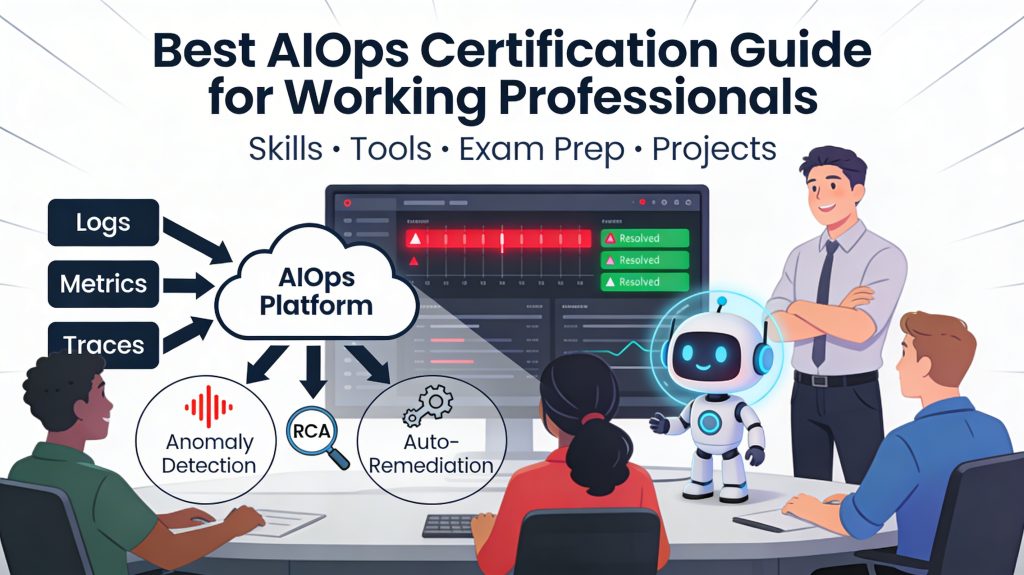
Modern IT operations are becoming complex and data-heavy. Systems generate massive logs, metrics, and events every second. Manual monitoring is no longer enough. Teams now need intelligent automation, predictive insights, and faster incident response. This is where Artificial Intelligence for IT Operations (AIOps) plays a key role. It combines AI, machine learning, and automation to improve reliability, reduce noise, and automate recovery.
The AiOps Certified Professional (AIOps) certification prepares engineers and managers to work in intelligent, automated operations environments. It teaches how to detect anomalies, correlate events, predict failures, and automate incident response using data-driven insights. This guide explains the certification in simple language — what you learn, how to prepare, and how it supports your long-term career.
Comparison (AIOps vs Related Tracks)
| Category | AIOps Certified Professional (AIOps) | DevOps Track | DevSecOps Track | SRE Track | MLOps Track | DataOps Track | FinOps Track |
|---|---|---|---|---|---|---|---|
| Primary Goal | Use AI/ML to improve IT operations | Faster delivery using automation | Build security into delivery | Improve uptime and reliability | Run ML models reliably in production | Deliver reliable data pipelines | Control and optimize cloud cost |
| Main Focus | Anomaly detection, correlation, prediction, automation | CI/CD, IaC, containers, pipelines | Security scanning, policy, compliance automation | SLOs, incident response, reliability engineering | Training, deployment, monitoring of models | Data quality, orchestration, governance | Budgeting, tagging, optimization, chargeback |
| Typical Data Used | Logs, metrics, traces, events | Build/deploy data, infra state | Security events, scan reports | SLIs, logs, latency, error rates | Features, model metrics, drift signals | Pipeline logs, data quality metrics | Usage and billing data, cost metrics |
| Key Outcomes | Less alert noise, faster RCA, fewer outages | Faster releases, stable deployments | Lower security risk, fewer gaps | Better uptime, predictable performance | Stable ML in production | Trustworthy data delivery | Lower spend, better governance |
| Best Fit Roles | AIOps Engineer, SRE, Platform/Cloud Ops | DevOps Engineer, Platform Engineer | Security/DevSecOps Engineer | SRE, Reliability Engineer | ML/MLOps Engineer | Data Engineer, Analytics Engineer | FinOps, Cloud Ops, Managers |
| Prerequisites | Monitoring + Ops basics, data thinking | Dev + Ops basics | DevOps + security basics | Linux, networking, monitoring | Python + ML basics | Data pipeline basics | Cloud billing + cost basics |
| Tools Mindset | Intelligence + automation-first | Automation-first | Security-first automation | Reliability-first practices | ML lifecycle automation | Data lifecycle automation | Cost governance + optimization |
| When to Choose | When ops data is too noisy/large | When delivery speed is top priority | When security must be integrated early | When uptime and SLAs are critical | When ML must be production-ready | When pipelines need stable delivery | When cloud cost control is required |
| How AIOps Adds Value | Predicts issues and automates response | Adds smarter monitoring and response | Adds anomaly detection to security ops | Adds prediction + correlation to incidents | Adds ops intelligence to ML monitoring | Adds anomaly detection to pipeline health | Predicts cost spikes and anomalies |
AiOps Certified Professional (AIOps)
What it is
AiOps Certified Professional focuses on using Artificial Intelligence and Machine Learning to improve IT operations. It helps you analyze operational data, detect unusual patterns, predict failures, and automate incident response.
Who should take it
- DevOps Engineers
- SRE Engineers
- Cloud and Platform Engineers
- Operations and Support Engineers
- Engineering Managers
- Professionals working in monitoring, automation, or reliability
Skills you’ll gain
After completing the AiOps Certified Professional (AIOps), you gain the ability to make IT operations smarter and more automated using AI and data. You learn how to detect issues early, reduce alert noise, predict failures, and automate incident response. These skills help you improve system reliability, speed up recovery, and build intelligent, self-healing infrastructure in real production environments.
- AIOps architecture and core concepts
- Machine learning in IT operations
- Intelligent monitoring and observability
- Anomaly detection and pattern recognition
- Event correlation and alert noise reduction
- Predictive failure detection
- Root cause analysis using operational data
- Automation and self-healing systems
Real-world projects you should be able to do
After completing the AiOps Certified Professional (AIOps), you should be able to apply intelligent, data-driven operations in real production environments. You learn how to turn large volumes of logs and metrics into actionable insights, detect problems early, and automate responses to improve system stability and reliability.
- Build intelligent alert correlation system
- Create anomaly detection for logs and metrics
- Predict system failures using historical data
- Automate incident detection and remediation
- Reduce alert noise and false alerts
- Implement data-driven root cause analysis
- Build self-healing automation for failures
- Design AIOps monitoring and automation pipeline
Preparation Plan
A clear and structured plan helps you understand AIOps step by step and apply it in real environments. Choose the timeline based on your experience and learning pace.
7–14 Days (Fast Track)
Focus on core AIOps fundamentals, anomaly detection, observability basics, and simple automation concepts. This stage builds your foundation and helps you understand how intelligent operations work.
30 Days (Balanced)
Practice analyzing logs and metrics, build a small anomaly detection example, and learn predictive monitoring and event correlation. This phase balances theory with hands-on learning.
60 Days (Advanced)
Build a complete AIOps pipeline, work with real incident datasets, implement intelligent alert correlation, and create self-healing automation for common system failures. This stage helps you gain deeper practical expertise and real-world confidence.
Common mistakes
- Ignoring monitoring fundamentals
- Studying theory without hands-on practice
- Trying ML without understanding data
- Expecting AI to solve problems automatically
- Not understanding observability properly
Best next certification after this
After completing AiOps Certified Professional (AIOps), the best next step depends on what direction you want your career to grow in. Here are three clear options:
- Same track (deeper in AIOps): MLOps Certified Professional
Best if you want to move from AIOps usage to building and managing ML models in production. - Cross-track (strong reliability focus): SRE Certified Professional
Best if you want stronger reliability engineering skills like SLOs, incident management, and production stability. - Leadership track (management/architecture): DevOps Manager or DevOps Architect certification
Best if you want to lead teams, design platforms, and drive automation strategy across engineering and operations.
Choose Your Path
Different professionals reach AIOps from different backgrounds. The paths below show a simple and logical journey toward AiOps Certified Professional (AIOps) based on your career direction.
DevOps Path
Start → DevOps Fundamentals → CI/CD → Containers → Monitoring → AIOps
This path is ideal for DevOps engineers who want to enhance automation with intelligence. After learning monitoring and observability, AIOps helps you predict issues, reduce alerts, and automate recovery.
DevSecOps Path
Start → DevOps Basics → Security Automation → DevSecOps → Observability → AIOps
Best for professionals focused on secure and automated systems. AIOps strengthens anomaly detection, improves threat visibility, and supports intelligent automated response.
SRE Path
Start → Linux → Monitoring → Reliability → Incident Management → AIOps
Designed for reliability-focused engineers. AIOps improves incident prediction, alert correlation, and enables self-healing systems to maintain higher uptime.
AIOps / MLOps Path
Start → Python → ML Basics → Observability → AIOps → AIOps → MLOps
Suitable for professionals interested in AI-driven operations. After applying AIOps in operations, you can expand into MLOps to manage the full machine learning lifecycle and automation.
DataOps Path
Start → Data Pipelines → Observability → Data Quality → AI in Ops → AIOps
Ideal for data professionals who want to apply analytics and machine learning in operational environments to improve system intelligence and automation
FinOps Path
Start → Cloud → Cost Monitoring → Optimization → Predictive Analytics → AIOps
Best for cloud cost and optimization roles. AIOps helps detect usage anomalies, predict cost spikes, and automate cost optimization decisions.
Role → Recommended Certifications
| Role | Recommended Certifications |
|---|---|
| DevOps Engineer | DevOps → Kubernetes → Monitoring → AIOps |
| SRE | Reliability → Observability → AIOps |
| Platform Engineer | Kubernetes → Automation → Observability → AIOps |
| Cloud Engineer | Cloud → Monitoring → Automation → AIOps |
| Security Engineer | DevSecOps → Security Monitoring → AIOps |
| Data Engineer | DataOps → ML Basics → AIOps |
| FinOps Practitioner | FinOps → Cost Analytics → AIOps |
| Engineering Manager | DevOps Manager → SRE → AIOps |
Next Certifications to Take
Same Track
Advanced AIOps / MLOps Professional
Cross Track
SRE Certified Professional
Leadership Track
DevOps Architect / Engineering Manager
Career Value of AIOps
AIOps is becoming essential in modern IT operations. Organizations want professionals who can detect issues early, automate responses, and improve reliability using data-driven insights. After completing this certification, you gain the ability to design predictive and self-healing systems, making you highly valuable in DevOps, SRE, and cloud environments.
Training & Certification Support Institutions
If you want to prepare for AiOps Certified Professional (AIOps) with better clarity and hands-on support, these institutions and learning platforms can help you. They are useful for working professionals because they focus on practical learning, structured guidance, and certification readiness.
DevOpsSchool
DevOpsSchool provides a structured learning path with labs, real-world examples, and project-based practice. It helps learners build strong fundamentals in monitoring, automation, and intelligent operations. The training is practical and certification-focused, which makes preparation easier.
Cotocus
Cotocus supports professionals with industry-oriented training and consulting exposure. It is helpful for understanding how AIOps fits into real enterprise operations and how teams use monitoring, automation, and AI-driven insights in production environments.
ScmGalaxy
ScmGalaxy focuses on DevOps and automation training with practical exercises. It helps learners build the base skills needed for AIOps, such as CI/CD awareness, monitoring basics, and operational troubleshooting. This makes it a good support option for beginners and intermediate learners.
BestDevOps
BestDevOps provides training support with hands-on learning and real implementation guidance. It is useful for professionals who want step-by-step learning and practical problem-solving practice aligned with modern operations needs.
devsecopsschool.com
A learning platform focused on DevSecOps. It helps professionals understand secure automation, security testing in pipelines, and security monitoring. This is useful because AIOps is often used alongside security operations to detect anomalies and reduce incident impact.
sreschool.com
A learning platform focused on Site Reliability Engineering. It teaches reliability basics such as SLOs, monitoring, incident response, and uptime improvement. Since AIOps depends heavily on good observability and incident handling, this platform supports strong AIOps foundations.
aiopsschool.com
A dedicated learning platform for AIOps. It focuses directly on anomaly detection, event correlation, alert noise reduction, predictive monitoring, root cause analysis, and self-healing automation. This makes it one of the most relevant platforms for AIOps certification preparation.
dataopsschool.com
A platform focused on DataOps and data pipeline reliability. AIOps works best when operational data is clean and consistent, so DataOps learning improves your ability to manage logs, metrics, and event data properly.
finopsschool.com
A platform focused on FinOps and cloud cost optimization. AIOps can help detect cost anomalies and usage spikes, so FinOps knowledge supports AIOps in cloud-heavy environments where both reliability and cost control matter.
FAQs (General)
1. Is the AiOps Certified Professional (AIOps) certification hard?
It is moderately difficult. If you already know basic DevOps, monitoring, and automation, the concepts are easier to understand.
2. How much time is needed to prepare?
Most learners prepare in about 30 to 60 days, depending on their background and daily practice.
3. Do I need prior knowledge of machine learning?
Only a basic idea is helpful. You do not need deep machine learning skills because the focus is on using AI in operations, not building complex models.
4. Who is the ideal candidate for this certification?
It is suitable for DevOps Engineers, SREs, Cloud and Platform Engineers, Operations professionals, and Engineering Managers.
5. Does AIOps help in career growth?
Yes. Many companies are moving toward intelligent operations, and AIOps skills are increasingly valuable worldwide.
6. Is programming required?
Basic scripting knowledge such as Python or Shell is useful, but advanced programming is not necessary.
7. What is the main advantage of learning AIOps?
You learn to detect problems early, reduce alert noise, automate incident handling, and improve system reliability using data.
8. Can beginners take this certification?
Yes, but understanding DevOps basics, Linux, and monitoring will make learning easier.
9. What career roles are possible after certification?
Common roles include AIOps Engineer, SRE, DevOps Engineer, Platform Engineer, and Reliability Engineer.
10. Will AIOps replace DevOps?
No. AIOps builds on DevOps by adding intelligence and predictive automation.
11. Is hands-on practice important for this certification?
Yes. Practical understanding and real-world application are key parts of learning AIOps.
12. Is this certification useful for managers?
Yes. It helps managers improve automation, system stability, and overall operational efficiency.
FAQs on AiOps Certified Professional (AIOps)
1. What is AiOps Certified Professional (AIOps)?
It is a professional certification that validates your ability to apply Artificial Intelligence and Machine Learning in IT operations to improve monitoring, automation, and system reliability.
2. Who should take the AIOps certification?
DevOps Engineers, SREs, Cloud and Platform Engineers, Operations professionals, and Engineering Managers who want to build intelligent and automated operations skills.
3. What are the prerequisites for AIOps certification?
Basic knowledge of DevOps, Linux, monitoring, and automation is recommended. Deep machine learning knowledge is not mandatory.
4. How does this certification help in real work?
It helps you detect anomalies early, reduce alert noise, automate incident response, and improve system reliability using data-driven insights.
5. What skills does this certification focus on?
AIOps concepts, anomaly detection, event correlation, predictive monitoring, root cause analysis, and automation for self-healing systems.
6. Is AIOps certification valuable for career growth?
Yes. Organizations are adopting intelligent operations, and professionals with AIOps expertise are in high demand globally.
7. How long does it take to prepare for AIOps certification?
Most professionals prepare within 30 to 60 days depending on their experience and practice time.
8. Is AIOps certification worth doing?
Yes. It prepares you for modern IT operations where automation, predictive analytics, and intelligent monitoring are becoming essential.
Conclusion
IT operations are moving toward intelligent, automated, and predictive systems. Manual monitoring is no longer enough for modern distributed environments. The AiOps Certified Professional (AIOps) certification equips engineers and managers with practical skills to build intelligent, automated, and self-healing systems. It helps reduce downtime, improve performance, and strengthen system reliability using data and automation.
As organizations continue adopting AI-driven operations, professionals with AIOps expertise are becoming essential. This certification provides a strong foundation for future-ready careers in DevOps, SRE, and modern cloud operations, helping you stay competitive in an increasingly data-driven technology landscape.