
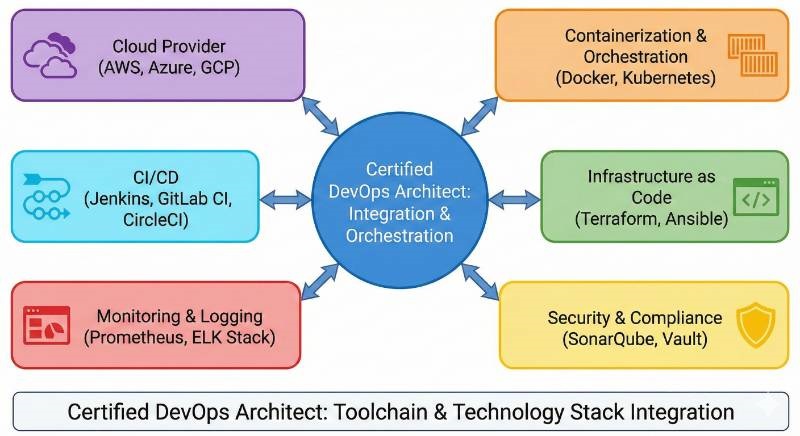
If you are looking to grow your career in IT, you have probably heard that “knowing tools” is no longer enough. To reach the top levels as a senior engineer or manager, you need to understand how all those tools fit together. This is where the Certified DevOps Architect (CDA) program comes in.
The CDA is a professional roadmap that teaches you how to design the entire system, not just fix one part of it. It moves you from being someone who follows instructions to someone who builds the strategy for the whole company. Whether you are working in India or anywhere else in the world, this certification proves you have the skills to lead a modern tech team.
Understanding the CDA Program
The Certified DevOps Architect (CDA) is an advanced-level credential that validates an individual’s proficiency in designing end-to-end software delivery systems. Unlike entry-level certifications that focus on tool-specific commands, the CDA emphasizes the “Architectural Blueprint”—integrating CI/CD, Infrastructure as Code (IaC), Security, and Cloud Strategy into a cohesive framework.
The program is provided by DevOpsSchool and is recognized for its heavy emphasis on real-world scenarios and hands-on laboratory work.
Who Should Take Certified DevOps Architect (CDA)?
Certified DevOps Architect (CDA) is ideal for professionals who already understand DevOps basics and now want to move into architecture-level responsibilities. If you are a working DevOps/Cloud/Platform engineer, senior software engineer, SRE, or an engineering manager who needs to design scalable CI/CD pipelines, automation frameworks, and reliable production platforms, this certification fits you well.
- DevOps Engineers wanting to become Architects
- Senior Software Engineers moving to platform roles
- SRE / Cloud / Platform Engineers
- Engineering Managers leading DevOps teams
- Technical Leads handling CI/CD & automation
- Professionals targeting high-paying DevOps Architect roles
Skills You Will Gain
With the Certified DevOps Architect (CDA) program, you will gain the practical architecture skills needed to design and run DevOps at scale. You’ll learn how to build strong CI/CD systems, plan cloud-native platforms, automate infrastructure, improve reliability and monitoring, and bring security into the delivery pipeline.
- DevOps Architecture Design
- CI/CD pipeline scaling and optimization
- Cloud-native platform architecture
- Infrastructure as Code strategy
- Observability & monitoring design
- DevSecOps integration and security automation
- Reliability engineering and SLO/SLA planning
- Release strategy & deployment models
- Automation and orchestration design
- Cost and performance optimization
Real-World Projects You Should Be Able To Do After CDA
After completing Certified DevOps Architect (CDA), you should be able to design and deliver real production-ready DevOps solutions, not just demos. This includes building scalable CI/CD pipelines, setting up cloud-native deployment platforms, automating infrastructure using IaC, implementing full monitoring and logging, and creating secure release workflows with DevSecOps checks.
- Design enterprise-level CI/CD architecture
- Build scalable Kubernetes platform
- Create multi-cloud DevOps architecture
- Implement full observability stack
- Design secure DevSecOps pipeline
- Build zero-downtime deployment strategy
- Create Infrastructure-as-Code blueprint
- Architect high-availability production platform
Preparation Plan
7–14 Days
Focus on fundamentals. Review DevOps lifecycle, CI/CD concepts, containers, cloud basics, and architecture patterns. Practice Git, pipelines, Docker, and Kubernetes fundamentals. Understand how real systems are deployed.
30 Days
Build a real project. Create full CI/CD pipeline, automate infrastructure, deploy containerized apps, implement monitoring and logging, and test scaling. Study architecture design patterns and reliability concepts.
60 Days
Move to advanced level. Design multi-region architecture, implement DevSecOps, build observability platform, optimize performance, simulate failures, and practice real-world troubleshooting and architectural thinking.
Common Mistakes
Common mistakes include studying only theory, skipping hands-on practice, focusing on tools instead of architecture thinking, and having weak Linux, networking, or troubleshooting skills. Many learners also ignore monitoring, reliability, and security topics, which are key for a DevOps Architect role.
- Only studying theory
- Ignoring hands-on practice
- Not understanding system design
- Weak Linux and networking basics
- No real pipeline troubleshooting
- Tool-focused learning instead of architecture thinking
- Not practicing scalability and failure scenarios
Best Next Certification After CDA
- Leadership Track: DevOps Manager / DevOps Leadership Certification
- Same Track: Advanced DevOps Professional Certification
- Cross Track: SRE Certification or DevSecOps Certification
Choose Your Path: 6 Learning Tracks
Depending on your career goals, you can tailor your journey through these specialized paths:
- DevOps Path: Focuses on the core lifecycle—automation, CI/CD, and infrastructure orchestration.
- DevSecOps Path: Integrates security into every stage of the pipeline (Shift-Left security).
- SRE Path: Emphasizes building highly available and reliable systems through engineering discipline.
- AIOps/MLOps Path: Leverages AI/ML for operations and automates the machine learning lifecycle.
- DataOps Path: Focuses on the automated, high-quality delivery of data for analytics and AI.
- FinOps Path: Bridges the gap between engineering and finance to optimize cloud spending.
Role → Recommended Certifications
| Current Role | Recommended Certification Roadmap |
| DevOps Engineer | CDA Professional → DevSecOps Professional → CDA Advanced |
| SRE | CDA Foundation → SRE Professional → CDA Professional |
| Platform Engineer | CDA Professional → CDA Advanced → Kubernetes Specialist |
| Cloud Engineer | CDA Foundation → AWS/Azure Solutions Architect → CDA Professional |
| Security Engineer | DevSecOps Foundation → DevSecOps Professional → CDA Advanced |
| Data Engineer | CDA Foundation → DataOps Professional → CDA Professional |
| FinOps Practitioner | FinOps Professional → CDA Advanced |
| Engineering Manager | CDA Foundation → CDA Advanced → FinOps Professional |
Institutional Support for CDA Training
To achieve the Certified DevOps Architect credential, specialized training and mentorship are recommended. These institutions provide a mix of theory and practical labs:
- DevOpsSchool:
The primary provider for the CDA credential. They offer 120+ hours of live training, 3 real-time projects, and lifetime validity for their certifications. - Cotocus:
Known for hands-on, project-based training that helps engineers apply architectural concepts to real enterprise environments. - Scmgalaxy:
A leading community and training hub focusing on the technical deep-dives required for the CDA exam. - BestDevOps:
Offers intensive bootcamps focused on fast-tracking engineers into architect roles. - devsecopsschool.com:
Specializes in the security track for architects. - sreschool.com:
Dedicated to SRE and reliability engineering education. - aiopsschool.com:
The go-to source for AI-driven operations and MLOps training. - dataopsschool.com:
Focuses on automating data pipelines and DataOps governance. - finopsschool.com:
Specialized in cloud financial management and cost optimization for architects.
Frequently Ashed Questions
1. Is the CDA exam difficult?
Yes, it is an advanced-level certification. It tests your ability to solve scenario-based problems rather than just recalling facts.
2. How long does the exam take?
The exam is typically 3 hours long, consisting of multiple-choice and multiple-select questions.
3. Are there prerequisites for the CDA?
While there are no mandatory blockers, it is highly recommended to complete the “Master in DevOps Engineering” or have significant hands-on experience before the Architect level.
4. What is the recommended sequence of certifications?
The standard flow is: Foundation → Professional → Architect (CDA) → Manager (CDM).
5. How does this certification help my career?
It validates your ability to lead technical teams and design enterprise-scale systems, which is highly sought after by top-tier global employers.
6. Does the CDA expire?
Certifications from DevOpsSchool are generally valid for a lifetime with no renewal fees.
7. Can a non-coder become a DevOps Architect?
While you don’t need to be a senior developer, you must be comfortable with scripting (Python/Bash) and YAML configuration.
8. Is cloud knowledge required?
Yes. A basic understanding of at least one major cloud provider (AWS/Azure/GCP) is essential.
9. How long is the preparation period?
Most working professionals find that 30 to 60 days of focused study is sufficient.
10. What is the passing score?
Candidates generally need a score of 70% or higher to pass the online-proctored exam.
11. Are there lab assignments in the CDA program?
Yes. The training includes at least 3 real-time scenario-based projects that cover the full software delivery lifecycle.
12. Can I take the training and exam online?
Yes, all CDA programs are available online with live instructor-led sessions and remote-proctored exams.
FAQs on Certified DevOps Architect (CDA)
1. What is the primary goal of the CDA certification?
The goal is to validate that a professional can design a “self-service” platform that enables teams to deliver software with speed, safety, and scale.
2. Does the CDA curriculum cover Kubernetes?
Yes, Kubernetes orchestration is a core pillar of the CDA Professional and Advanced levels.
3. Is there a focus on cost (FinOps)?
Yes, the CDA Advanced level specifically covers how to design cost-effective architectures to avoid cloud bill shocks.
4. Does the certification include security?
Yes, DevSecOps principles like “Policy as Code” and automated security gates are integrated into the architecture modules.
5. What is the “next step” after passing the CDA?
You can specialize further (e.g., SRE Certified Professional) or move into leadership (Certified DevOps Manager).
6. Is the CDA recognized in India?
Yes, it is highly recognized in the Indian IT sector, specifically by major service providers and product-based startups.
7. How are the scenario-based questions structured?
They present a business problem (e.g., high downtime during releases) and ask you to choose the best architectural solution from several technical options.
8. Can I get a refund if I fail?
Most providers offer mock tests to ensure you are ready before the actual attempt, reducing the risk of failure.
Conclusion
Certified DevOps Architect (CDA) is a strong step for engineers and managers who want to move from tool-level DevOps work to architecture-level ownership. It helps you design scalable CI/CD systems, build reliable cloud platforms, automate infrastructure, and bring security and observability into real production delivery. If you follow a practical plan and build real projects while learning, CDA can prepare you for DevOps Architect, Platform Architect, and senior leadership roles in India and global teams.