
Your Blueprint for Mastering AWS Cloud Architecture
Transitioning from traditional infrastructure to the cloud isn’t just about learning new tools; it’s about shifting your mindset. Having navigated the evolution of IT from physical data centers to the current cloud-native era, I’ve seen many certifications come and go. However, the AWS Certified Solutions Architect – Associate (CSAA) remains the gold standard for anyone serious about building scalable, resilient, and cost-effective systems.
The Landscape of AWS Certifications
Before we dive deep into the Solutions Architect path, it is vital to see where it fits in the broader AWS ecosystem. Below is a comprehensive look at the primary certification tracks.
| Track | Level | Who it’s for | Prerequisites | Skills Covered | Recommended Order |
| Cloud Practitioner | Foundational | Beginners, Sales, Managers | None | Basic Cloud Concepts, Security, Pricing | 1st |
| Solutions Architect | Associate | Developers, Admins, Architects | Basic AWS Knowledge | Design Resilient & High-Performing Architectures | 2nd |
| Developer | Associate | Software Engineers | Coding experience | Developing, Deploying, Debugging Cloud Apps | 2nd or 3rd |
| SysOps Administrator | Associate | System Admins, SREs | Operations experience | Deployment, Management, Operations on AWS | 2nd or 3rd |
| Solutions Architect | Professional | Senior Architects | CSAA suggested | Complex Design, Scalability, Migration | 4th |
| DevOps Engineer | Professional | DevOps/SREs | Developer or SysOps Assoc. | Automation, CI/CD, Governance, Security | 4th |
| Security | Specialty | Security Engineers | Associate level cert | Data Protection, Encryption, Incident Response | 5th |
| Data Engineer | Associate | Data Engineers | Basic Data Analytics | Data Pipelines, Storage, Security | 3rd |
Detailed Breakdown: AWS Certified Solutions Architect – Associate
What it is
The AWS CSAA is a certification that validates your ability to design and deploy enterprise-grade applications on AWS. It focuses on the AWS Well-Architected Framework, ensuring you can build systems that are secure, high-performing, resilient, and efficient.
Who should take it
- Software Engineers looking to understand the infrastructure their code runs on.
- System Administrators moving into Cloud Engineering roles.
- Engineering Managers who need to make informed decisions about cloud costs and architecture.
- Aspiring DevOps and SRE professionals.
Skills you’ll gain
- High Availability: Designing systems that don’t fail, using Multi-AZ and Auto Scaling.
- Cost Optimization: Selecting the right instances (Spot, Reserved, On-Demand) to save money.
- Security: Mastering IAM, VPC Security Groups, and Encryption.
- Decoupling: Using SQS and SNS to build microservices that scale independently.
- Data Strategy: Choosing between RDS, DynamoDB, S3, and Aurora based on use cases.
Real-world projects you should be able to do
- Host a multi-tier web application with a load balancer and auto-scaling group.
- Set up a disaster recovery plan using S3 Cross-Region Replication.
- Migrate an on-premise database to AWS RDS with minimal downtime.
- Implement a serverless image processing pipeline using Lambda and S3.
Preparation Plan
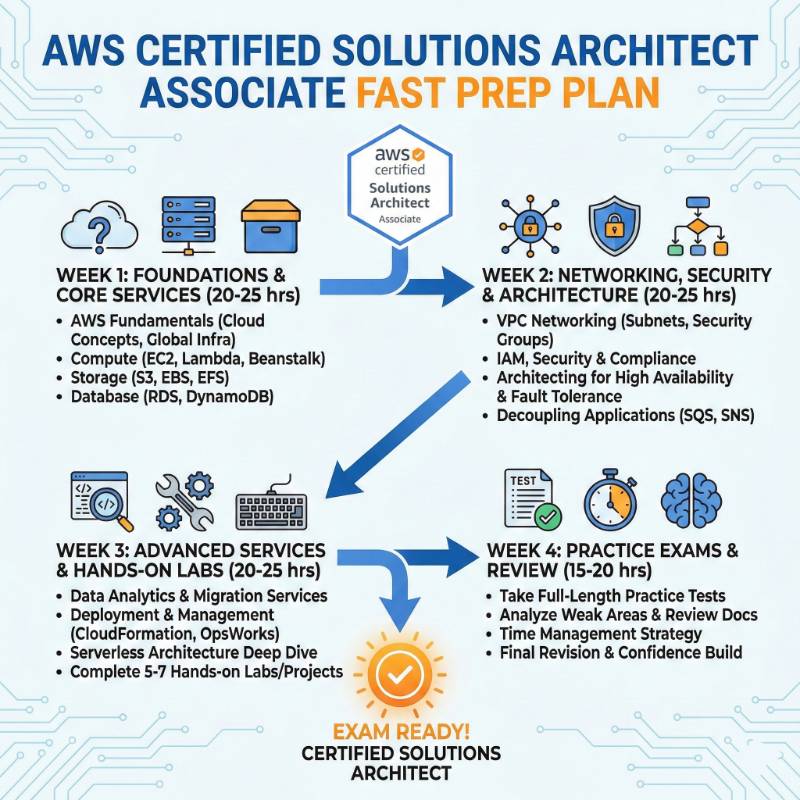
- 7–14 Days (The Fast Track):
Only for those already working on AWS daily. Focus on whitepapers, FAQs, and 2-3 full-length practice exams. - 30 Days (The Standard Pace):
1-2 hours a day. Cover a structured video course, perform 10-12 hands-on labs, and review the Well-Architected Framework. - 60 Days (The Deep Dive):
For beginners. Spend the first 30 days building small projects. Spend the next 30 days refining theoretical knowledge and practicing exam techniques.
Common Mistakes
- Ignoring Networking: Many fail because they don’t understand VPCs, Subnets, and Routing Tables deeply enough.
- Relying on Exam Dumps: AWS changes the exam frequently. If you don’t understand the “why,” you will fail the scenario-based questions.
- Underestimating Storage: Knowing the difference between S3 classes (Standard vs. Glacier vs. Intelligent Tiering) is crucial.
Best next certification after this
For most, the AWS Certified Solutions Architect – Professional is the natural peak, but many choose to pivot into the AWS Certified Security – Specialty to bolster their DevSecOps credentials.
Choose Your Path: 6 Specialized Learning Tracks
Architecting is the foundation. Here is how you should steer your learning after getting certified:
- DevOps Path:
Focus on AWS CodePipeline, CloudFormation, and Jenkins integration. Move toward the DevOps Engineer Professional. - DevSecOps Path:
Prioritize AWS WAF, Shield, GuardDuty, and IAM. Aim for the Security Specialty. - SRE Path:
Focus on CloudWatch, X-Ray, and AWS Resilience Hub to master observability and reliability. - AIOps/MLOps Path:
Learn SageMaker, Lex, and Rekognition. Bridge the gap between data science and production. - DataOps Path:
Master AWS Glue, Redshift, and EMR to build robust data pipelines. - FinOps Path:
Deep dive into Cost Explorer, AWS Budgets, and Compute Optimizer to manage cloud spend effectively.
Role → Recommended Certifications Mapping
| Role | Recommended Certifications |
| DevOps Engineer | CSAA → Developer Associate → DevOps Engineer Professional |
| SRE | CSAA → SysOps Associate → DevOps Engineer Professional |
| Platform Engineer | CSAA → SysOps Associate → Security Specialty |
| Cloud Engineer | Cloud Practitioner → CSAA → SysOps Associate |
| Security Engineer | CSAA → Security Specialty |
| Data Engineer | CSAA → Data Engineer Associate → Data Analytics Specialty |
| FinOps Practitioner | Cloud Practitioner → CSAA |
| Engineering Manager | Cloud Practitioner → CSAA |
Next Certifications to Take
Based on industry trends and the evolving needs of software engineers, here are your three best options after completing the CSAA:
- Same Track (Deepening): AWS Certified Solutions Architect – Professional. This is for those who want to be the lead authority on high-level design.
- Cross-Track (Broadening): AWS Certified Security – Specialty. Security is no longer “someone else’s job.” Every architect must be a security expert.
- Leadership/Management: Certified Kubernetes Administrator (CKA). While not an AWS cert, mastering Kubernetes is essential for any modern Engineering Manager or Lead Architect.
Top Institutions for Training and Certification Support
Choosing the right training partner is essential for hands-on experience. Here are the top providers that offer comprehensive support for the AWS CSAA:
- DevOpsSchool:
A premier institution known for its deep-dive technical sessions and expert-led training. They provide extensive labs and real-world project scenarios that go beyond the exam. - Cotocus:
Focuses on cloud-native technologies and provides streamlined paths for engineers looking to transition into architectural roles with mentorship. - Scmgalaxy:
A vast community-driven platform offering resources, tutorials, and practical guidance for SCM and Cloud professionals. - BestDevOps:
Offers specialized training modules focused on integrating AWS architecture with modern DevOps workflows. - DevSecOpsSchool.com:
The go-to place for those looking to integrate security into their AWS architecture from day one. - Sreschool.com:
Tailored for those who want to use their AWS knowledge to build highly reliable and observable systems. - Aiopsschool.com:
Bridges the gap between traditional AWS architecture and AI-driven operations. - Dataopsschool.com: Focuses on the data engineering side of the AWS ecosystem, perfect for aspiring Data Architects.
- Finopsschool.com:
Teaches the crucial skill of cloud financial management and cost optimization on AWS.
FAQs: AWS Certified Solutions Architect – Associate
General Program FAQs
- How difficult is the CSAA exam?
It is considered moderate to difficult. It requires a mix of theoretical knowledge and practical troubleshooting skills. - How long does it take to prepare?
Usually 1 to 3 months depending on your starting experience level. - Are there any prerequisites?
There are no formal prerequisites, but having a basic understanding of IT services and their use in the AWS platform is recommended. - In what sequence should I take AWS exams?
Start with Cloud Practitioner (optional but helpful), then Solutions Architect Associate, then either Developer or SysOps. - Is this certification worth it in today’s market?
Absolutely. It is consistently ranked among the highest-paying certifications globally and is often a requirement for cloud roles. - What are the career outcomes?
You can move into roles like Cloud Architect, Solutions Architect, or Senior Cloud Engineer, often with a significant salary bump. - How long is the certification valid?
It is valid for 3 years, after which you need to recertify. - Does the exam involve coding?
No, it is multiple-choice and multiple-response. However, understanding how code interacts with infrastructure is helpful. - Can I take the exam from home?
Yes, AWS offers online proctored exams through Pearson VUE. - What is the passing score?
The passing score is 720 out of 1000. - How much does the exam cost?
The standard price is $150 USD. - What if I fail the exam?
You must wait 14 days before you can retake it.
Technical & Focused FAQs
- What is the focus of the SAA-C03 (current version)?
It places a heavy emphasis on data security, resilient architectures, and high-performing serverless designs. - How much hands-on experience do I need?
AWS recommends one year of hands-on experience, but dedicated lab work can bridge this gap for many. - Do I need to know all 200+ AWS services?
No. You need to know the core 20-30 services (EC2, S3, RDS, VPC, IAM, Lambda, etc.) very deeply. - What is the “Well-Architected Framework”?
It is a set of 6 pillars (Security, Reliability, etc.) that AWS uses to evaluate the quality of an architecture. - Should I take the Developer Associate first?
Only if you spend 90% of your time writing code. For most, the Solutions Architect is a better starting point. - Does this certification cover Kubernetes (EKS)?
Yes, but at a high level. For deep K8s knowledge, you would look at the Specialty or CKA exams. - How important is VPC knowledge?
Critically important. Networking is often the section where most candidates lose points. - Will this help me with Azure or Google Cloud?
The concepts (Load balancing, Object storage, IAM) are similar, making it much easier to learn other clouds later.
Conclusion
Taking on the AWS Certified Solutions Architect – Associate is more than just a line on your resume. It represents a fundamental shift in how you view technology—moving from managing individual servers to designing global, self-healing systems. Having seen the industry transition from physical hardware to the fluid, automated world of the cloud, I can tell you that the principles you learn here are the building blocks for the next decade of your career.
Whether you are an engineer in India looking to break into global roles or a manager aiming to lead high-performing teams, this certification provides the common language you need to succeed. Don’t just aim to pass the exam; aim to understand the “why” behind every architectural decision. The cloud is a vast ocean, and this certification is your compass.
