
Introduction
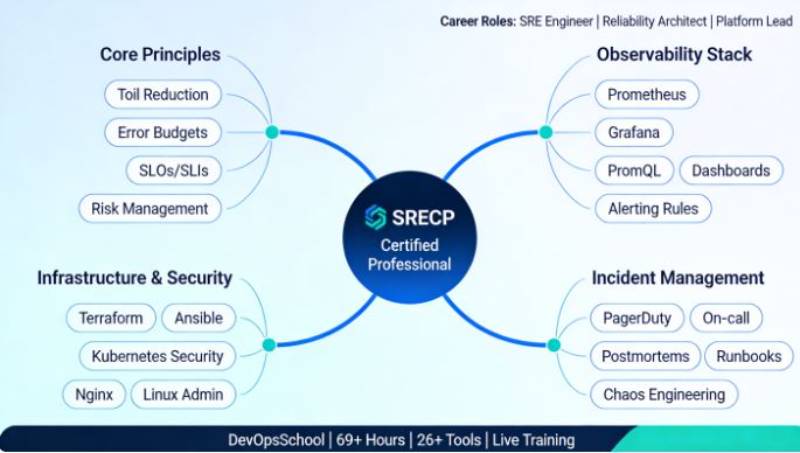
Site Reliability Engineering (SRE) is a discipline that integrates software engineering with IT operations to ensure that large-scale systems are reliable, scalable, and efficient. The Site Reliability Engineering Certified Professional (SRECP) certification validates your expertise in managing complex systems and infrastructure, building automation solutions, and applying best practices to improve the reliability and performance of applications and services.
If you are a software engineer, DevOps practitioner, or an IT professional aiming to specialize in Site Reliability Engineering, this guide will provide comprehensive details about the SRECP certification and how it can benefit your career.
What is Site Reliability Engineering Certified Professional (SRECP)?
The Site Reliability Engineering Certified Professional (SRECP) is an industry-recognized certification that validates the skills required to manage and maintain scalable, highly reliable systems. The certification covers a broad range of topics, including system monitoring, incident management, performance tuning, and the application of best practices in automation and infrastructure management.
Who Should Take It?
The SRECP certification is ideal for individuals in the following roles:
- Site Reliability Engineers (SRE)
- DevOps Engineers
- Platform Engineers
- Cloud Engineers
- System Administrators
- Infrastructure Engineers
Professionals looking to enhance their skills in system reliability, improve their organization’s service uptime, and adopt automation best practices should pursue this certification.
Skills You’ll Gain
Upon completion of the SRECP certification, you’ll gain the following skills:
- Incident Management: Managing high-impact incidents and reducing downtime.
- System Design: Designing highly available, scalable, and efficient systems.
- Automation: Implementing automation to manage infrastructure at scale.
- Performance Tuning: Optimizing system performance for better reliability.
- Monitoring & Alerting: Setting up and managing monitoring tools to track system health.
- Capacity Planning: Ensuring infrastructure can scale to meet demand.
- Disaster Recovery: Implementing recovery processes to ensure business continuity.
Real-World Projects You Should Be Able to Do After it
With the knowledge gained from the SRECP certification, you will be able to handle real-world projects such as:
- Designing Fault-Tolerant Systems: Architecting systems to tolerate failures without affecting service availability.
- Automating System Management: Building automation scripts and tools to reduce manual intervention in system maintenance.
- Implementing Monitoring and Logging: Setting up monitoring systems and centralized logging for proactive incident management.
- Improving Incident Response Time: Developing efficient incident management workflows to reduce system downtime.
- Optimizing System Performance: Tuning the performance of large-scale systems to enhance responsiveness.
Preparation Plan
7-Day Plan (for individuals with a solid foundation):
- Day 1-2: Focus on incident management and monitoring. Study best practices for real-time alerting and response.
- Day 3-4: Dive into automation concepts. Work with tools like Ansible, Puppet, and Chef to automate system management.
- Day 5-6: Study system design, capacity planning, and disaster recovery strategies.
- Day 7: Take mock tests, revise, and identify areas that need further attention.
30-Day Plan (for intermediate professionals):
- Week 1: Focus on understanding incident management and troubleshooting.
- Week 2: Learn about the monitoring, alerting, and automation of infrastructure.
- Week 3: Study system design, performance tuning, and capacity planning.
- Week 4: Practical sessions and mock tests. Focus on high-availability systems and disaster recovery.
60-Day Plan (for beginners):
- Week 1-2: Get a strong grasp of incident management and automation.
- Week 3-4: Dive deeper into performance tuning, system design, and disaster recovery.
- Week 5-6: Work on hands-on projects, review case studies, and take mock exams.
Common Mistakes
Here are some common mistakes to avoid during your SRECP preparation:
- Ignoring Incident Management: Incident management is at the core of SRE. Failing to understand this will lead to poor response times.
- Skipping Performance Tuning: Performance tuning is essential for ensuring system reliability and scalability.
- Not Practicing Enough: Hands-on practice is crucial. Spend time working on real-world scenarios and mock tests.
- Overlooking Capacity Planning: This can result in systems that fail under heavy load or during scaling events.
- Neglecting Automation: Automation is key to ensuring that your systems are both scalable and easy to manage.
Best Next Certification After This
After completing the SRECP, you can consider the following certifications to continue your learning:
- DevOps Certifications: Expands your knowledge of continuous integration, continuous deployment, and automation.
- AIOps Certification: For those looking to integrate AI-driven automation into their operations.
- Cloud Certifications: To focus on cloud infrastructure and services.
Choose Your Path
As an SRE, you can follow various career paths to specialize further. Some options include:
- DevOps
Focus on CI/CD pipelines, configuration management, and automation to streamline software delivery and improve collaboration between development and operations teams. - DevSecOps
Integrate security into DevOps practices to ensure secure systems and applications by addressing security issues at every stage of the software development lifecycle. - SRE (Site Reliability Engineering)
Specialize in system reliability and scalability, ensuring large-scale systems run efficiently, are fault-tolerant, and remain highly available. - AIOps/MLOps
Leverage AI and machine learning to automate operations, monitor system performance, and proactively address issues at scale.
AIOps/MLOps
Leverage AI and machine learning to automate operations, monitor system performance, and proactively address issues at scale. - DataOps
Focus on data infrastructure management and automation, improving the flow of data, ensuring quality, and enabling better decision-making with automated data pipelines. - FinOps
Balance cloud cost management with optimal performance, ensuring that cloud services remain cost-effective without compromising system reliability and performance.
Each path offers distinct career opportunities, and choosing the right one depends on your interests and career goals.
Role → Recommended Certifications
Here’s a list of certifications you should pursue based on your role:
| Role | Recommended Certification |
|---|---|
| DevOps Engineer | DevOps Certified Professional (DCP) |
| SRE | Site Reliability Engineering Certified Professional (SRECP) |
| Platform Engineer | Cloud Architect, Kubernetes Certified Professional |
| Cloud Engineer | AWS Certified Solutions Architect, GCP Professional Cloud Architect |
| Security Engineer | Certified Information Systems Security Professional (CISSP) |
| Data Engineer | Google Professional Data Engineer |
| FinOps Practitioner | FinOps Certified Practitioner |
| Engineering Manager | Certified ScrumMaster (CSM), Project Management Professional (PMP) |
Frequently Asked Questions
1. What is Site Reliability Engineering (SRE)?
A brief overview of what SRE entails and how it differs from traditional IT operations.
2. How does SRE ensure system reliability?
Explain how SRE practices are designed to enhance uptime, scalability, and fault tolerance.
3. What are the core skills required for an SRE professional?
Discuss key competencies such as automation, incident management, performance tuning, and more.
4. Why is automation crucial in SRE practices?
Focus on the importance of automating manual processes to ensure efficiency and reduce human error.
5. What are the common tools used in SRE?
List some popular tools for monitoring, incident management, and performance optimization, such as Prometheus, Grafana, and Kubernetes.
6. How can the SRECP certification help advance your career?
Discuss the career benefits of earning the certification and how it can open doors in SRE and related fields.
7. How long does it typically take to prepare for the SRECP exam?
Provide an average timeframe for preparation and factors influencing it.
8. What is the structure of the SRECP exam?
Explain the types of questions, topics covered, and exam format.
9. What practical knowledge will I gain from the SRECP certification?
Highlight real-world skills and projects you can handle after earning the certification.
10. Is the SRECP certification suitable for beginners?
Discuss whether prior experience in IT operations or DevOps is necessary or if the certification is accessible to beginners.
11. What are the best next steps after earning the SRECP?
Discuss follow-up certifications and career paths, such as DevOps, AIOps, or advanced SRE certifications.
12. How does the SRECP differ from other DevOps certifications?
Compare the SRECP with other certifications in the DevOps and cloud operations space, like DevOps Professional or Cloud Architect certifications.
FAQs on SRECP
Here are the most frequently asked questions about the SRECP certification:
1. What is the difficulty level of the SRECP certification?
The SRECP is a mid-to-advanced level certification. It requires a solid understanding of systems, automation, and incident management.
2. How long does it take to prepare for the SRECP exam?
Preparation time varies depending on your background. On average, it takes about 30 to 60 days of focused study and practice.
3. What are the prerequisites for the SRECP certification?
There are no strict prerequisites, but familiarity with basic system administration, programming, and cloud technologies will be beneficial.
4. How do I register for the SRECP exam?
You can register for the exam through the official website.
5. What skills do I need to pass the exam?
You should be proficient in system reliability, incident management, automation, monitoring, and system performance.
6. What’s the value of the SRECP certification in the job market?
SRECP is highly valued by companies looking to improve the reliability and scalability of their systems. It’s a strong credential for advancing in DevOps, platform engineering, and SRE roles.
7. How is the SRECP exam structured?
The exam consists of multiple-choice questions that test your understanding of system reliability, automation, and performance tuning.
8. How can I improve my chances of passing the SRECP exam?
Focus on hands-on experience, understand the theory behind the concepts, and take multiple practice exams.
Next Certifications to Take
After completing the SRECP certification, consider the following next steps:
- Same Track: Site Reliability Engineering Expert Certification
- Cross Track: Cloud Certifications (AWS, Azure, GCP)
- Leadership: Project Management Professional (PMP)
Top Institutions Offering SRECP Training
Here are some top institutions that provide expert training for the Site Reliability Engineering Certified Professional (SRECP) certification:
- DevOpsSchool
DevOpsSchool offers comprehensive courses focused on Site Reliability Engineering (SRE), combining theoretical knowledge with hands-on training. Their courses prepare candidates to tackle real-world challenges in system reliability, performance tuning, and automation. - Cotocus
Specializing in both DevOps and SRE, Cotocus offers training that prepares professionals for the SRECP certification. Their programs include live projects to ensure candidates gain practical experience in system reliability and automation techniques. - Scmgalaxy
Scmgalaxy provides a blend of SRE and DevOps training, focusing on industry-relevant skills. Their programs cover key concepts in automation, monitoring, incident management, and more, preparing you for both the SRECP exam and the demands of the modern tech industry. - BestDevOps
BestDevOps offers in-depth courses that focus on SRE and DevOps principles, providing personalized mentoring to students. Their programs cover a wide array of topics necessary for passing the SRECP exam and excelling in real-world SRE tasks. - Sreschool.com
Sreschool.com is dedicated to SRE training and offers specialized certification programs. They focus on building practical skills for managing large-scale systems, incident management, and system optimization—key areas covered by the SRECP certification. - Aiopsschool.com
Although Aiopsschool.com focuses primarily on AIOps, it provides valuable insights into automation, making it a great resource for SRE professionals looking to incorporate AI-driven solutions into their operations. - Finopsschool.com
Finopsschool.com offers FinOps training but also includes valuable content related to SRE, particularly in managing cloud costs while maintaining the performance of infrastructure. This makes it ideal for professionals looking to integrate financial management with site reliability.
These institutions are well-regarded for their practical, industry-focused training, helping candidates acquire the skills and knowledge necessary to pass the SRECP certification and excel in the field of Site Reliability Engineering.
Conclusion
The Site Reliability Engineering Certified Professional (SRECP) certification is a powerful credential for those looking to advance in the fields of system reliability, automation, and infrastructure management. With the skills gained, you can significantly enhance your career prospects in the ever-evolving world of IT operations and DevOps.
Pursuing this certification will not only validate your expertise but also help you acquire the knowledge and skills necessary to manage large-scale, highly available systems efficiently. By following this guide, you’ll be well on your way to becoming a proficient Site Reliability Engineer and advancing your career in this growing domain.
