
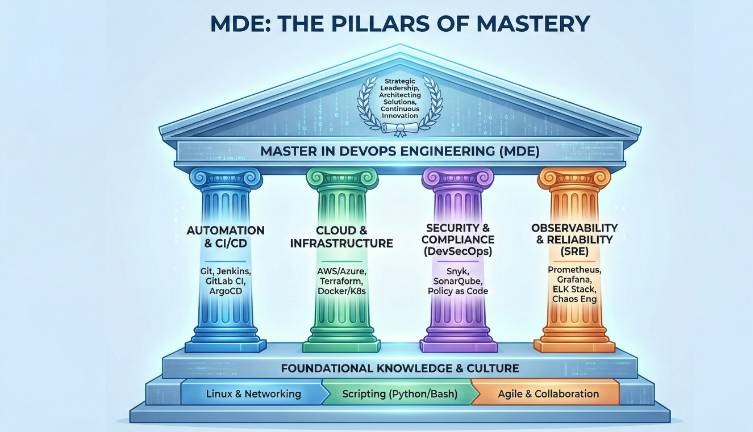
Introduction
In today’s fast-paced software development landscape, the demand for skilled DevOps professionals is higher than ever. The Master in DevOps Engineering (MDE) certification is designed to equip engineers with the advanced skills necessary to succeed in DevOps roles. This comprehensive guide will walk you through everything you need to know about the MDE certification, including its benefits, skills you’ll gain, real-world projects you can tackle after completion, and how to prepare for the exam.
This guide is specifically tailored for working engineers, software engineers, and managers who are looking to enhance their careers in the field of DevOps engineering. Whether you’re an engineer or a manager aiming for leadership roles, the MDE certification can significantly boost your career.
What is the Master in DevOps Engineering (MDE)?
The Master in DevOps Engineering (MDE) is an advanced-level certification program offered by DevOpsSchool. It covers the core principles, tools, and practices that are essential for professionals in the DevOps field. By completing this certification, you’ll gain in-depth knowledge of the DevOps lifecycle, automation, continuous integration, containerization, cloud computing, and security (DevSecOps).
The certification is ideal for professionals who want to deepen their understanding of DevOps and its real-world application. It helps bridge the gap between development and operations, ensuring faster delivery and higher-quality software.
Who Should Take the MDE Certification?
The MDE certification is designed for:
- Software Engineers looking to transition into DevOps or gain specialized skills.
- DevOps Engineers who want to advance their careers by mastering complex DevOps tools and practices.
- Engineering Managers who need to understand the DevOps lifecycle to guide their teams effectively.
- SREs (Site Reliability Engineers) aiming to improve the reliability, scalability, and automation of systems.
- Cloud Engineers, Platform Engineers, Security Engineers, and Data Engineers who work in environments that demand advanced DevOps skills.
Skills You’ll Gain
By completing the MDE certification, you will acquire critical DevOps skills, including:
- Continuous Integration/Continuous Deployment (CI/CD): Master automation tools like Jenkins, GitLab CI, and CircleCI.
- Containerization & Orchestration: Learn how to use Docker and Kubernetes to manage containers and orchestrate microservices.
- Cloud Computing & Infrastructure Automation: Gain expertise in cloud platforms like AWS, Azure, and Google Cloud, along with infrastructure automation tools like Terraform.
- Configuration Management: Master tools like Ansible, Chef, and Puppet for managing configurations at scale.
- DevSecOps: Integrate security practices into the DevOps pipeline, automating security checks and vulnerability management.
- Monitoring & Logging: Learn to use tools like Prometheus, Grafana, and ELK Stack for monitoring, logging, and troubleshooting.
Real-World Projects You Should Be Able to Do After MDE
Upon completing the MDE certification, you will be equipped to work on the following real-world projects:
- Building and Managing CI/CD Pipelines: Automate testing, building, and deployment of applications using Jenkins or GitLab.
- Deploying Microservices on Kubernetes: Use Docker and Kubernetes to create, deploy, and manage containerized applications at scale.
- Setting Up Cloud Infrastructure: Automate infrastructure provisioning using Terraform on AWS or Azure.
- Implementing DevSecOps Practices: Integrate security tools such as Snyk and SonarQube into CI/CD pipelines for secure code deployments.
- Monitoring and Troubleshooting Systems: Use tools like Prometheus, Grafana, and ELK Stack to monitor system performance and troubleshoot issues in real-time.
Preparation Plan
The preparation plan for the MDE certification will vary depending on your current experience and knowledge of DevOps. Here are the recommended preparation timelines:
7-14 Days Plan (For Professionals with Prior Experience)
- Day 1-7: Refresh your understanding of DevOps fundamentals such as CI/CD, version control, and cloud platforms.
- Day 8-14: Focus on hands-on practice with tools like Jenkins, Docker, Kubernetes, Terraform, and cloud platforms (AWS, Azure).
30 Days Plan (For Intermediate Professionals)
- Day 1-7: Study the basics of DevOps, CI/CD, and containerization.
- Day 8-14: Deep dive into cloud platforms (AWS, Azure) and infrastructure automation tools (Terraform).
- Day 15-30: Focus on advanced topics like DevSecOps, microservices, and continuous delivery, with hands-on labs for each topic.
60 Days Plan (For Beginners)
- Day 1-15: Learn the fundamentals of software development, version control, and basic automation.
- Day 16-30: Get familiar with core DevOps tools like Jenkins, Docker, and GitLab.
- Day 31-45: Focus on container orchestration, cloud platforms, and infrastructure automation with Terraform.
- Day 46-60: Study security integration (DevSecOps), monitoring, and troubleshooting DevOps pipelines.
Common Mistakes to Avoid
While preparing for the MDE certification, here are some common mistakes to avoid:
- Not practicing enough: DevOps is a hands-on field, so ensure you engage with real-world projects to solidify your knowledge.
- Skipping security practices: Security should be integrated from the beginning. DevSecOps practices must not be an afterthought.
- Focusing solely on theory: Practical knowledge is essential for success. Work on labs and projects to apply the concepts.
- Overloading on too many tools: Stick to the essential tools that are most widely used in the industry and master them.
Best Next Certification After MDE
After successfully completing the MDE certification, consider pursuing the following advanced certifications:
- DevSecOps Master: For a deeper understanding of security practices in DevOps.
- Certified Kubernetes Administrator (CKA): Specialize in container orchestration and Kubernetes management.
- AWS Certified DevOps Engineer: Focus on cloud engineering and automation on AWS.
Choose Your Path: Learning Paths
Depending on your career goals and interests, you can specialize further by pursuing one of the following learning paths. Each path allows you to dive deeper into a specific area of DevOps and its related fields, ensuring that you gain the expertise needed to excel in your chosen domain:
DevOps
Master the complete DevOps lifecycle, from planning and coding to deployment and monitoring. This path focuses on automating software development and IT operations, ensuring faster delivery, improved quality, and seamless collaboration between development and operations teams.
DevSecOps
Learn to integrate security into the DevOps pipeline to ensure secure software delivery. This path focuses on automating security practices and incorporating security measures at every stage of development, testing, deployment, and monitoring.
SRE (Site Reliability Engineering)
Focus on system reliability, monitoring, and scalability for large-scale systems. This path is perfect for those who want to ensure the reliability and performance of production systems, emphasizing automation, incident response, and performance optimization.
AIOps/MLOps
Combine artificial intelligence and machine learning with DevOps practices for smarter operations and automation. This path focuses on using AI and ML to enhance automation, improve operational efficiency, and optimize DevOps pipelines through data-driven decision-making.
DataOps
Learn to automate and optimize data workflows, pipelines, and analytics for real-time data processing. This path is ideal for those working in data engineering or analytics, ensuring that data pipelines are reliable, scalable, and aligned with DevOps principles.
FinOps
Learn to manage and optimize cloud spending, ensuring financial efficiency while implementing DevOps practices. This path is designed for professionals focusing on financial operations in the cloud, balancing cost management with optimal resource utilization.
Role → Recommended Certifications
| Role | Recommended Certifications |
|---|---|
| DevOps Engineer | MDE, Certified Kubernetes Administrator, AWS Certified DevOps Engineer |
| SRE (Site Reliability Engineer) | MDE, Google Cloud Professional Cloud Architect, SRE Certification |
| Platform Engineer | MDE, AWS Solutions Architect, HashiCorp Certified Terraform Associate |
| Cloud Engineer | AWS Certified DevOps Engineer, MDE, Google Cloud Professional Cloud Architect |
| Security Engineer | MDE, CISSP (Certified Information Systems Security Professional) |
| Data Engineer | MDE, Microsoft Azure Data Engineer Associate |
| FinOps Practitioner | MDE, Certified FinOps Practitioner |
| Engineering Manager | MDE, Leadership in DevOps, Certified ScrumMaster (CSM) |
8 FAQs About the Master in DevOps Engineering (MDE)
- What is the Master in DevOps Engineering (MDE) certification?
The MDE certification is a program designed to teach professionals the core principles, tools, and practices of DevOps, with a focus on automation, cloud computing, and continuous delivery. - What prerequisites are required for the MDE certification?
While there are no formal prerequisites, a basic understanding of software engineering or IT operations will be helpful. - How long does it take to complete the MDE certification?
Completion time can vary, but typically ranges from 7 days for experienced professionals to 60 days for beginners. - What tools are covered in the MDE certification?
The certification covers tools like Jenkins, Docker, Kubernetes, Terraform, Ansible, AWS, Azure, and more. - Is MDE certification recognized globally?
Yes, it is recognized globally and is respected by employers worldwide. - How much does the MDE certification cost?
Pricing varies depending on the training provider and package. Contact DevOpsSchool for detailed pricing. - Can I take the MDE exam remotely?
Yes, the exam is available online, allowing you to take it from anywhere. - What career benefits will I get from MDE?
The MDE certification opens up high-paying opportunities in DevOps, SRE, Cloud Engineering, and other related roles, making you a highly competitive candidate in the job market.
Top Institutions Offering MDE Training and Certification
Several institutions offer high‑quality training and certification for Master in DevOps Engineering (MDE). These organizations provide hands‑on learning, expert instructors, and career support:
DevOpsSchool
Offers expert‑led training, real‑world projects, and career support. Known for comprehensive DevOps courses with practical labs and mock interviews.
Cotocus
Provides practical training with real‑time case studies. Focuses on cloud fundamentals, CI/CD practices, and DevOps tools like Jenkins, Docker, and Kubernetes.
Scmgalaxy
Focuses on tool‑based learning and hands‑on exercises. Offers interactive labs and real‑time project simulations to build skills in Docker, Kubernetes, and cloud automation.
BestDevOps
Known for practical, hands‑on DevOps courses, covering tools like Jenkins, Git, Docker, and Terraform. Ideal for professionals seeking foundational and advanced skills.
devsecopsschool.com
Specializes in DevSecOps with courses on automating security in DevOps pipelines, vulnerability management, and secure CI/CD practices.
sreschool.com
Offers training for Site Reliability Engineers (SREs), focusing on reliability, scalability, incident response, and system monitoring.
dataopsschool.com
Focuses on DataOps, teaching data pipeline automation and real‑time analytics for efficient data processing and decision‑making.
finopsschool.com
Specializes in FinOps, covering cloud cost optimization, budgeting, resource rightsizing, and financial management in DevOps environments.
These institutions cater to various DevOps disciplines and offer practical, real‑world experience, helping you advance your career with the MDE certification.
Conclusion
The Master in DevOps Engineering (MDE) certification is an essential credential for anyone looking to advance their career in DevOps. By mastering key DevOps practices, tools, and real-world applications, you will be equipped to take on challenging and rewarding roles in software engineering and IT operations. Whether you’re a beginner or an experienced professional, the MDE certification will set you up for success in the fast-evolving world of DevOps.
