
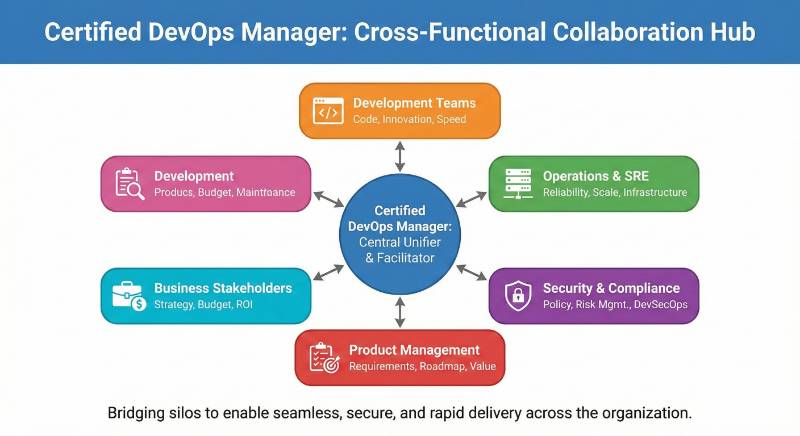
Introduction
In many companies, the real problem is not writing code. The real problem is getting the code released on time without breaking anything. Releases become slow because teams depend on manual steps, approvals are unclear, testing takes too long, and nobody has full visibility of what is happening.
The Certified DevOps Manager (CDM) certification is for people who want to manage this better. It teaches how to lead DevOps work across teams by setting clear processes, improving coordination, using simple metrics, reducing release risk, and building a culture of continuous improvement. If you are an engineer moving into leadership or a manager responsible for delivery, this guide will help you understand CDM and its value for your career.
What Is Certified DevOps Manager (CDM)?
CDM validates leadership skills to run DevOps across teams with predictable delivery and stable operations. It focuses on operating model, governance, metrics, and continuous improvement.
Certified DevOps Manager:
Certified DevOps Manager (CDM) validates leadership and management skills needed to run DevOps across teams using an operating model—ownership, governance, measurable metrics, and continuous improvement. It focuses on making delivery consistent and reliable, not just setting up tools.
Why Certified DevOps Manager exists?
DevOps succeeds in early stages when a single team controls most changes. It gets harder when multiple teams share services, dependencies increase, and compliance needs grow. CDM exists to help leaders manage DevOps at this scale with clear decision-making and repeatable practices.
Who should take it
- Senior DevOps/Platform/SRE engineers moving into leadership
- Engineering managers responsible for release stability and speed
- Cloud and platform leads managing multi-team governance
- Transformation leads driving DevOps adoption
- Professionals in regulated environments needing controlled delivery
Skills you’ll gain
- Ownership models and workflow design across teams
- Release governance and guardrails that reduce risk
- Metrics selection and improvement planning
- Stakeholder alignment and change management
- Reliability-aligned leadership practices
- Continuous improvement using feedback loops
Who This Guide Is For?
This guide is for working professionals who build, release, support, or manage software in real environments. It is most useful if you are responsible for delivery speed, release stability, incident maturity, governance decisions, or cross-team execution and want to grow into DevOps leadership through CDM.
What you will get from this guide?
You will get a clear understanding of what CDM covers and how it maps to real DevOps management responsibilities. You will also get practical learning paths, preparation timelines, role-to-certification mapping, and refreshed FAQs to support your decision and planning.
About Provider
DevOpsSchool is the provider of the Certified DevOps Manager (CDM) certification program. The program is designed to build leadership capability for running DevOps as a measurable operating model across teams.
What CDM Is Really Testing
CDM is really testing whether you can lead DevOps as a system, not as a set of tools. It checks if you can take real delivery problems—slow releases, repeated failures, incident overload, unclear ownership, and security or compliance pressure—and respond with practical decisions that improve outcomes.
Leadership under real delivery pressure
CDM checks how you respond to real problems: release delays, repeated failures, incident spikes, and cross-team conflicts. It tests your decision-making, not your memory.
Operating model and governance thinking
It validates your ability to design a way of working that teams can follow consistently—ownership rules, workflow standards, and practical guardrails.
Metrics-driven improvement
CDM expects you to use metrics to improve outcomes, not just display dashboards. It checks whether you understand which signals matter and what actions they should trigger.
Certification Table
| Certification | Track | Level | Who it’s for | Prerequisites | Skills covered | Recommended order |
|---|---|---|---|---|---|---|
| DevOps Certified Professional (DCP) | DevOps | Foundation | Beginners and early-career engineers | Linux + Git basics | DevOps fundamentals, CI/CD concepts | 1 |
| Certified DevOps Engineer (CDE) | DevOps | Intermediate | Engineers building automation | CI/CD basics, scripting | Pipelines, automation patterns, IaC basics | 2 |
| Certified DevOps Professional (CDP) | DevOps | Advanced | Engineers owning production delivery | Strong CI/CD + cloud basics | Production DevOps practices, ops readiness | 3 |
| Certified DevOps Manager (CDM) | DevOps | Leadership | Leads, managers, senior engineers | Delivery ownership, real DevOps exposure | Strategy, governance, metrics, adoption | 4 |
| Certified DevOps Architect (CDA) | DevOps | Architect | Architects, platform owners | Strong DevOps + systems thinking | Platform design, scale patterns | 5 |
| DevSecOps specialization | DevSecOps | Advanced | Security + delivery leaders | DevOps baseline + security basics | Secure delivery controls, compliance mindset | Cross-track |
| SRE specialization | SRE | Advanced | Reliability owners | Production ops exposure | SLIs/SLOs, incidents, reliability practices | Cross-track |
| AIOps/MLOps specialization | AIOps/MLOps | Advanced | Ops automation leaders | Observability basics | Automation, insights, noise reduction | Cross-track |
| DataOps specialization | DataOps | Advanced | Data engineering leads | Data pipelines basics | Quality, governance, orchestration | Cross-track |
| FinOps specialization | FinOps | Advanced | Cost governance owners | Cloud usage basics | Cost visibility, optimization, accountability | Cross-track |
Real-world projects you should be able to do after it
After completing CDM, you should be able to take charge of real-world DevOps challenges and implement solutions that improve both speed and stability. You will be able to design and implement a comprehensive DevOps operating model across multiple teams, where everyone understands their roles and responsibilities.
1) Build a DevOps operating model for multiple teams
- Define ownership for build, release, on-call, rollback, and security checks
- Create workflow rules, escalation paths, and clarity across teams
- Publish a responsibility map that teams can follow
2) Create release governance that does not slow delivery
- Define risk tiers and apply controls based on risk
- Set readiness standards and ensure rollback planning
- Replace manual approvals with automated guardrails
3) Improve CI/CD reliability and predictability
- Reduce flaky pipelines and unstable test stages
- Standardize pipeline templates for teams
- Create quality gates and “stop-the-line” rules for critical issues
4) Define safe deployment and rollback standards
- Apply canary, phased, or blue-green approaches where suitable
- Define rollback triggers and clear execution steps
- Ensure monitoring supports release validation
5) Improve incident management and learning culture
- Standardize severity levels and escalation paths
- Run postmortems that produce preventive actions
- Reduce repeat incidents through systematic fixes
6) Build a DevOps metrics scorecard for leadership
- Track flow: lead time and deployment frequency
- Track stability: change failure rate and rollback rate
- Track recovery: MTTR and incident trends
7) Remove delivery bottlenecks end-to-end
- Identify delays like approvals, environment issues, manual testing
- Improve one value stream and measure improvement
- Show outcomes: faster releases, fewer failures, quicker recovery
8) Create a platform adoption and enablement plan
- Design self-service standards and onboarding
- Build playbooks, templates, and enablement steps
- Track adoption and remove friction for teams
Preparation plan (7–14 days / 30 days / 60 days)
A preparation plan is a structured timeline that tells you what to learn, practice, and revise to become exam-ready and job-ready.
7–14 days
- Focus on scenario thinking and governance decisions
- Review metrics and operating model concepts
- Practice answering real-world delivery problems
30 days
- Week 1: Flow, ownership, and team collaboration
- Week 2: Governance, guardrails, and change management
- Week 3: Reliability leadership and incident practices
- Week 4: Adoption plan and maturity roadmap
60 days
- Month 1: Build strong foundations with real examples
- Month 2: Apply CDM practices to one delivery stream
- Document measurable improvements for career stories
Common mistakes
- Memorizing definitions but failing scenario questions
- Measuring speed only and ignoring reliability
- Adding approvals instead of guardrails
- Leaving ownership unclear across teams
- Running retros without real corrective actions
- Ignoring stakeholders until escalation
Best next certification after this.
Best next certification means choosing the right follow-up certification based on what you want to own next. It can be a deeper DevOps track, cross-track specialization, or leadership expansion.
Choose Your Path
Pick the track that matches your next responsibility area.
DevOps path
Best for: DevOps leads managing delivery speed and stability.
Sequence: Foundation → Engineer → Professional → Manager → Architect
DevSecOps path
Best for: Leaders building secure-by-default delivery pipelines.
Sequence: DevOps baseline → DevSecOps specialization → CDM governance
SRE path
Best for: Reliability owners managing incidents and SLO maturity.
Sequence: DevOps baseline → SRE specialization → CDM governance
AIOps/MLOps path
Best for: Leaders driving automation and intelligent operations.
Sequence: DevOps baseline → AIOps/MLOps specialization → leadership adoption
DataOps path
Best for: Data engineering leads improving pipeline quality and delivery.
Sequence: DataOps specialization → governance + flow + adoption leadership
FinOps path
Best for: Cloud cost owners working with engineering leadership.
Sequence: DevOps baseline → FinOps practices → CDM-style governance
Role → Recommended Certifications Mapping
| Role | Suggested progression |
|---|---|
| DevOps Engineer | DCP → CDE → CDP → CDM |
| SRE | DevOps baseline → SRE specialization → CDM |
| Platform Engineer | CDP → CDM → DevOps Architect direction |
| Cloud Engineer | DevOps baseline → DevOps engineer/pro path → CDM for leadership |
| Security Engineer | DevOps baseline → DevSecOps specialization → CDM |
| Data Engineer | DevOps baseline → DataOps specialization → CDM |
| FinOps Practitioner | Cloud basics → FinOps track → CDM for governance leadership |
| Engineering Manager | CDM first → cross-track specialization based on org needs |
Next Certifications to Take After CDM
Next certifications after CDM depend on your next career goal: deeper DevOps, cross-track specialization, or leadership expansion.
Same track option
Move toward DevOps Architect direction if you want to design platforms and delivery systems across many teams.
Cross-track option
Choose based on your organization needs:
- DevSecOps for security-driven delivery
- SRE for reliability and operations maturity
- DataOps for data delivery governance
- FinOps for cost governance and optimization culture
- AIOps/MLOps for intelligent automation and insights
Leadership option
Expand your leadership scope by combining CDM thinking with cost, reliability, or data governance depending on what you own next.
Training and Certification Support Institutions
DevOpsSchool
DevOpsSchool supports structured learning aligned to real DevOps outcomes. It helps working professionals strengthen scenario thinking, governance clarity, and measurable improvement planning.
Cotocus
Cotocus supports enterprise-focused implementation thinking. It helps learners understand practical delivery governance and automation decisions under real constraints.
ScmGalaxy
ScmGalaxy supports CI/CD and automation learning journeys with structured guidance. It is useful for professionals who want strong fundamentals and consistency.
BestDevOps
BestDevOps supports practical preparation with a guided approach. It suits working professionals who want clarity, practice, and job-aligned learning.
DevSecOpsSchool
DevSecOpsSchool focuses on security integrated into delivery. It supports secure pipelines, policy thinking, and governance controls.
SRESchool
SRESchool focuses on reliability engineering practices. It supports SLIs/SLOs, incident maturity, and operational excellence.
AIOpsSchool
AIOpsSchool focuses on operations intelligence and automation. It supports event correlation, noise reduction, and automation workflows.
DataOpsSchool
DataOpsSchool focuses on reliable data delivery. It supports pipeline quality, orchestration, and governance.
FinOpsSchool
FinOpsSchool focuses on cloud cost governance. It supports cost visibility, optimization practices, and accountability.
Frequently Asked Questions
- Is CDM difficult for beginners?
CDM is not ideal for complete beginners. It is more suited for those with foundational DevOps knowledge and experience in delivery or production environments. Familiarity with CI/CD, pipelines, and team workflows will help ease the learning process. - How long does CDM preparation take for working professionals?
The preparation time varies based on your experience:
- 7–14 days for experienced leads who already have a solid understanding of DevOps leadership.
- 30 days is ideal for most working professionals who want to refresh their knowledge and focus on practical scenarios.
- 60 days if you’re aiming for a deep understanding and want to apply it in real-world projects before taking the exam.
- Do I need strong coding skills for CDM?
No, coding skills are not a requirement for CDM. While having a basic understanding of scripting helps, CDM primarily tests your ability to manage teams, define processes, and make leadership decisions related to DevOps workflows, governance, and improvement. - What topics should I master before taking CDM?
Before taking CDM, focus on:
- Delivery flow: How software is delivered from development to production
- Ownership and roles: Understanding the roles and responsibilities within DevOps teams
- Release governance: Ensuring safe and stable releases
- Incident management: Handling production incidents and minimizing downtime
- Metrics and improvement: Using data to drive continuous improvement and efficiency
- What is the biggest difference between CDM and engineer-level DevOps certifications?
Engineer-level certifications focus on the technical aspects of building and automating pipelines. CDM, on the other hand, focuses on leadership, governance, and scaling DevOps practices across teams. It helps you lead teams, manage processes, and make decisions that align with organizational goals. - What kind of questions are common in CDM preparation?
You’ll typically face scenario-based questions that challenge you to think about how you would manage real-world DevOps issues. Examples:
- “Releases are failing regularly—what changes would you make?”
- “Team ownership is unclear—how do you address this?”
- “Incidents happen often. What steps would you take to reduce these?”
- What prerequisites should I have for CDM?
While there are no strict prerequisites, it’s recommended that you have some practical experience in DevOps, either as an engineer or manager. You should have hands-on knowledge of pipelines, cloud environments, and team workflows. Real exposure to production releases, incidents, or delivery planning will make your preparation more relevant. - Is CDM useful for engineering managers?
Yes, CDM is especially valuable for engineering managers. It provides the skills to manage delivery, streamline release governance, ensure system reliability, and align teams effectively. If you’re responsible for managing the speed, stability, and quality of releases, CDM will enhance your leadership skills in these areas. - Is CDM valuable for careers in India and outside India?
Absolutely. The skills taught in CDM—like leadership, governance, metrics-driven improvement, and cross-team alignment—are in high demand globally. Whether you’re working in India or elsewhere, CDM helps you manage scalable DevOps practices that are valued in any market. - What outcomes should I target after learning CDM?
Post-CDM, you should be able to deliver:
- Fewer failed releases
- Faster recovery from incidents
- Clearer ownership and accountability across teams
- Measurable improvements in release predictability and stability
- Increased collaboration and smoother cross-team communication
- What is the best certification sequence around CDM?
If you’re new to DevOps leadership, a good sequence is:
- DCP → CDE → CDP → CDM
For senior professionals: - CDM first (if you’re already leading delivery) → cross-track specialization based on organizational needs.
- What should I take after CDM?
- Same track: Move towards DevOps Architect certification to design platform-wide systems and delivery solutions.
- Cross-track: Specialize in SRE, DevSecOps, DataOps, FinOps, or AIOps depending on your organization’s needs.
- Leadership expansion: Pursue certifications that broaden your leadership role across cost governance, reliability, or data delivery.
- Can CDM help in promotions and leadership growth?
Yes, CDM is specifically designed to boost your leadership credentials. It helps you scale your impact, build credibility with stakeholders, and make decisions that align with business goals, which can directly contribute to promotions and expanded responsibilities. - How do I prove CDM capability in interviews?
The best way to prove your CDM capability in interviews is by sharing specific examples where you led teams or initiatives that resulted in measurable improvements. Talk about challenges like failed releases or incidents and explain how you applied CDM principles to fix them. Use metrics to show improvements in speed, reliability, or team collaboration.
FAQs on Certified DevOps Manager
- Who should take CDM first—engineer or manager?
Both can take CDM, but it is most beneficial for professionals who already lead or influence delivery decisions, release stability, or cross-team alignment. - Does CDM focus on DevOps tools like Kubernetes and Jenkins?
No, CDM does not deeply focus on specific tools. It is more about managing teams, defining governance, and applying metrics to improve delivery at scale. - What is the most common mistake while studying CDM?
The most common mistake is focusing too much on theory and definitions without practicing scenario-based answers. CDM is about making leadership decisions, not just recalling facts. - How can I study CDM in limited time?
If you’re short on time, focus on real-world scenarios: release failures, incidents, approval bottlenecks, and team ownership. Study how you would improve these problems through clear governance and decision-making. - What is one real project I should do during CDM prep?
Pick a delivery process you can improve, such as reducing release failures or improving rollback processes. Measure the outcome and use it as a real example to show how CDM principles work in practice. - Does CDM help in regulated industries?
Yes, CDM teaches governance and controls that are essential in regulated environments, allowing you to maintain compliance while still delivering quickly and efficiently. - Can CDM support a move into DevOps Architect later?
Yes, CDM prepares you for architectural decisions by teaching you how to scale DevOps across teams and manage system-wide delivery processes, which are key for DevOps Architects. - How do I keep CDM learning useful long-term?
Create a personal “DevOps Manager Playbook” and keep refining it based on feedback and outcomes from real projects. Regularly revisit it to ensure that your leadership principles stay fresh and relevant.
Conclusion
Certified DevOps Manager (CDM) is a strong certification for anyone who wants to lead DevOps outcomes instead of only running tools. It helps you build clarity in execution: standard workflows, clear ownership, meaningful metrics, safe releases, and real continuous improvement.
If you are a working engineer aiming for leadership, CDM helps you speak and act like a delivery leader. If you are already managing teams, CDM helps you reduce chaos and increase predictability—so teams ship faster, safer, and with more confidence.
